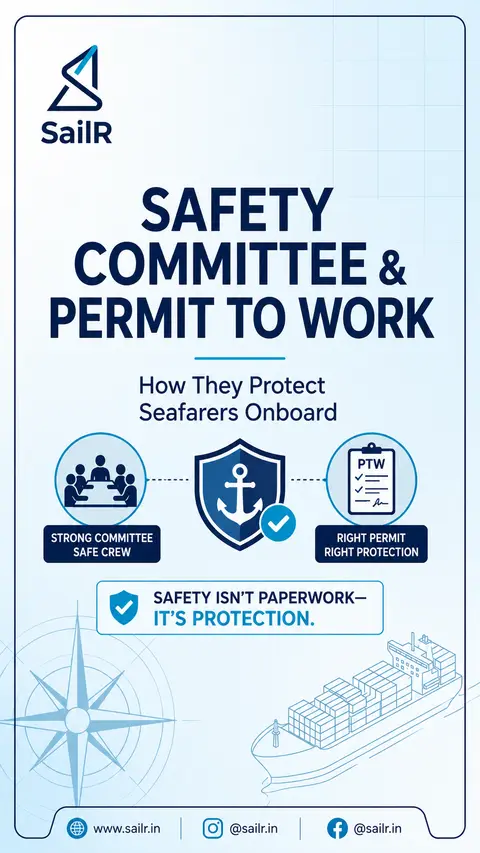
The slides, written out
AI-drawn illustration. Simplified to explain the idea, not to scale.
Slide 1 · SAFETY
SAFETY
COMMITTEE &
PERMIT TO WORK
How They Protect
Seafarers Onboard
PTW
STRONG COMMITTEE
SAFE CREW
RIGHT PERMIT
RIGHT PROTECTION
SAFETY ISN'T PAPERWORK—
IT'S PROTECTION.
Slide 2 · SafeR
SafeR
SAFETY
COMMITTEE
The Engine Room of Shipboard
Safety Culture
The Safety Committee coordinates, reviews and
drives safety to protect every seafarer onboard.
1
GIVES EVERYONE A VOICE
• Crew can raise concerns and report hazards
• Suggest safer ways of doing work
• Turn individual observations
into collective action
2
SYSTEMATIC REVIEW
• Reviews accidents, near misses and
inspection findings
• Learn from what went wrong
(and nearly went wrong)
• Prevent repeat incidents
3
INSPECTION & AUDIT
• Safety inspections of all accessible areas
• Conducted regularly
• Typical interval: at least once every
three months*
*In accordance with applicable flag-state requirements
and company procedures.
4
SAFETY FIRST
• Where provided under applicable regulations,
the Safety Officer can stop unsafe work
• Master decides when work can resume safely
• Protects every crew member from pressure
to take risks
COMMITMENT FROM MANAGEMENT
+ PARTICIPATION FROM CREW =
SAFER SHIPS
Slide 3 · PERMIT
PERMIT
TO WORK (PTW)
SYSTEM
A Procedural Safety Lock
for High-Risk Tasks
A formal, documented process that ensures
everyone is aligned before work begins.
1 DEFINE WORK SCOPE
Clearly identify the job to be done,
location and boundaries.
2 ASSESS HAZARDS & RISKS
Identify all potential hazards
and evaluate risks.
3 APPLY CONTROL MEASURES
Determine precautions, controls
and safe working methods.
4 VERIFY ISOLATION /
SAFETY ARRANGEMENTS
Ensure isolation, gas testing,
barriers and PPE are in place
where required.
5 OBTAIN AUTHORIZATION
Authorizing person reviews and
approves the permit.
6 START WORK SAFELY
Permit recipient confirms understanding
and starts work with all controls in place.
A PTW RECORDS
HAZARDS
Identified risks
associated
with the work.
CONTROL MEASURES
Precautions and safe
work methods to
mitigate risks.
PPE REQUIRED
Personal protective
equipment for
the job.
PERIOD OF VALIDITY
Start date, time
and expiry to avoid
outdated permits.
RESPONSIBLE
PERSONNEL
Who authorizes,
who performs,
who supervises.
A PERMIT DOES NOT
MAKE A JOB SAFE.
UNDERSTANDING IT
DOES.
KEY BENEFITS
Prevents
accidents
Eliminates
interface
hazards
Ensures clear
accountability
Protects every
seafarer onboard
Slide 4 · COMMON
COMMON
PERMITS ONBOARD
Used to control high-risk activities
and protect everyone on board.
HOT WORK PERMIT
Welding, cutting,
grinding and using
non-intrinsically
safe tools.
ENCLOSED SPACE
ENTRY PERMIT
Entering tanks,
cofferdams,
void spaces.
WORKING ALOFT /
OVERSIDE PERMIT
Work at height and
overboard operations.
ELECTRICAL
ISOLATION PERMIT
Lock-out / Tag-out
and working on or near
energized systems.
BEFORE ANY HIGH-RISK JOB, ASK:
What are
the hazards?
What controls
are in place?
Who authorized
the work?
Do I fully
understand
the permit?
SAFE WORK
SAVES LIVES
Your safety. Your ship. Our responsibility.
Drafted by SailR from our daily lessons. AI-drawn illustration. Simplified to explain the idea, not to scale. Last updated 19 Oct 2026.
Spotted a mistake?