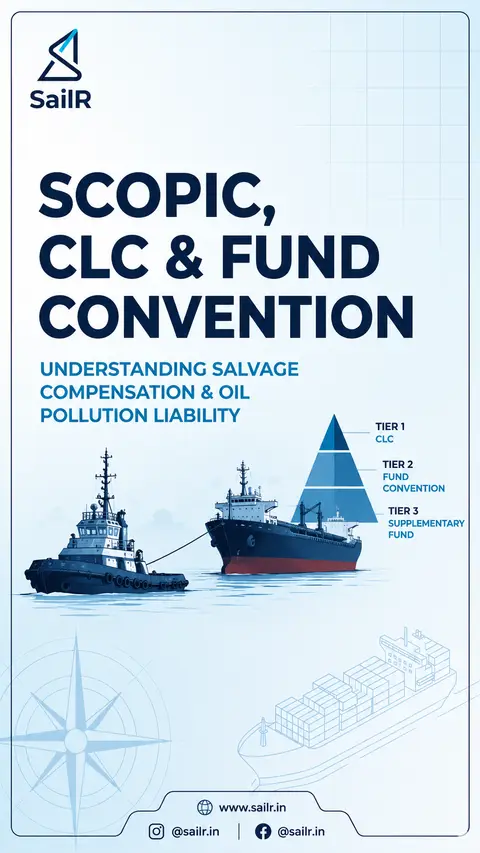
The slides, written out
AI-drawn illustration. Simplified to explain the idea, not to scale.
Slide 1 · SCOPIC,
SCOPIC,
CLC & FUND
CONVENTION
UNDERSTANDING SALVAGE
COMPENSATION & OIL
POLLUTION LIABILITY
TIER 1
CLC
TIER 2
FUND
CONVENTION
TIER 3
SUPPLEMENTARY
FUND
Slide 2 · SCOPIC CLAUSE
SCOPIC CLAUSE
EXPLAINED
A SPECIAL COMPENSATION P&I CLUB CLAUSE
SCOPIC is a contractual clause in the Lloyd's Open Form (LOF) that replaces Article 14 of the 1989 Salvage Convention once invoked by the salvor.
WHY WAS IT CREATED?
Addresses shortcomings of Article 14 special compensation regime
Encourages salvor engagement for environmental protection
Provides predictable, tariff-based remuneration
Improves response in marginal or total loss situations
Can be invoked globally without geographic limitations
HOW IT WORKS
1 LOF AGREED
Master and salvor agree Lloyd's Open Form (LOF) with SCOPIC clause.
2 SCOPIC INVOKED
Salvor formally invokes SCOPIC clause.
3 TARIFF RATES APPLY
Pre-agreed tariffs for personnel, tugs, equipment & expenses + bonus.
4 P&I SECURITY PROVIDED
P&I Club provides security for the anticipated remuneration.
5 OPERATION PROCEEDS
Salvage operation continues with financial certainty.
SCOPIC can be invoked without proving environmental damage or threat.
|
Slide 3 · SCOPIC
SCOPIC: ADVANTAGES
VS DISADVANTAGES
TWO SIDES OF THE SAME CLAUSE
SCOPIC protects the environment and ensures certainty for
salvors — but it also brings challenges for shipowners & P&I.
ADVANTAGES
CERTAINTY FOR SALVORS
Tariff-based remuneration means the salvor knows what they will recover.
QUICK DEPLOYMENT
Removes hesitation in marginal or low-value casualty situations.
ENVIRONMENTAL BENEFIT
Encourages salvors to engage even when the ship and cargo are a total loss.
SIMPLER DISPUTE RESOLUTION
Avoids the lengthy and complex Article 14 assessment process.
NO GEOGRAPHIC LIMITATION
Can be invoked anywhere, for wreck removal or other salvage operations.
DISADVANTAGES / CHALLENGES
COST TO SHIPOWNER / P&I
Tariff rates can be generous — P&I Club liability can become substantial once invoked.
NO INCENTIVE CEILING
A salvor on tariff rates may have less urgency to complete the operation efficiently.
COMPLEX MULTI-PARTY DYNAMICS
Involves salvors, P&I Clubs, hull underwriters, cargo underwriters — each with different interests.
POTENTIAL FOR MORAL HAZARD
SCOPIC could be invoked on straightforward jobs, leading to higher costs than a fair "no cure, no pay" award.
THE MASTER'S PRACTICAL ANGLE
Under the ISM Code (Article 5.2), you have overriding authority for safety and pollution prevention. SCOPIC protects the environment, but it also commits the shipowner's P&I cover in a way that the traditional LOF award doesn't. Follow your SMS procedures — and if the pollution threat is real, do not hesitate to agree LOF with SCOPIC included.
Slide 4 · WHO PAYS FOR TANKER OIL SPILLS?
WHO PAYS FOR TANKER OIL SPILLS?
THE THREE-TIER COMPENSATION PYRAMID
A global framework that ensures victims of persistent oil pollution receive adequate and reliable compensation.
TIER 1
CLC CONVENTION
Shipowner (with P&I Insurance)
Strict liability under the 1992 CLC
Compulsory insurance required
Right of direct action against insurer
LIMIT: UP TO 89.77 MILLION SDR*
TIER 2
1992 FUND CONVENTION
Oil Receivers in Fund Member States
Pays the difference when CLC limit is insufficient
Claim made directly to the Fund
LIMIT: UP TO 203 MILLION SDR*
(TOTAL INCLUDING CLC)
TIER 3
SUPPLEMENTARY FUND (2003 PROTOCOL)
Additional Global Support
Provides a further layer of compensation
Not all Fund Convention states have joined
LIMIT: UP TO 750 MILLION SDR*
(TOTAL INCLUDING TIERS 1 & 2)
*Limits as per current SDR values (subject to revision).
NON-TANKER SPILLS?
THE BUNKER CONVENTION (2001)
Covers spills of bunker oil from any ship over 1,000 GT
Based on CLC principles
Compulsory insurance up to the LLMC limit
STOPIA & TOPIA – THE P&I CLUBS' VOLUNTARY TOP-UP
STOPIA
(Small Tanker Oil Pollution Indemnification Agreement)
Raises the effective liability limit for small tankers (<29,548 GT)
Aligns them with larger vessels
TOPIA
(Tanker Oil Pollution Indemnification Agreement)
Provides indemnity to the Supplementary Fund
Covers 50% of its payments
Drafted by SailR from our daily lessons. AI-drawn illustration. Simplified to explain the idea, not to scale. Last updated 19 Oct 2026.
Spotted a mistake?