The slides, written out
AI-drawn illustration. Simplified to explain the idea, not to scale.
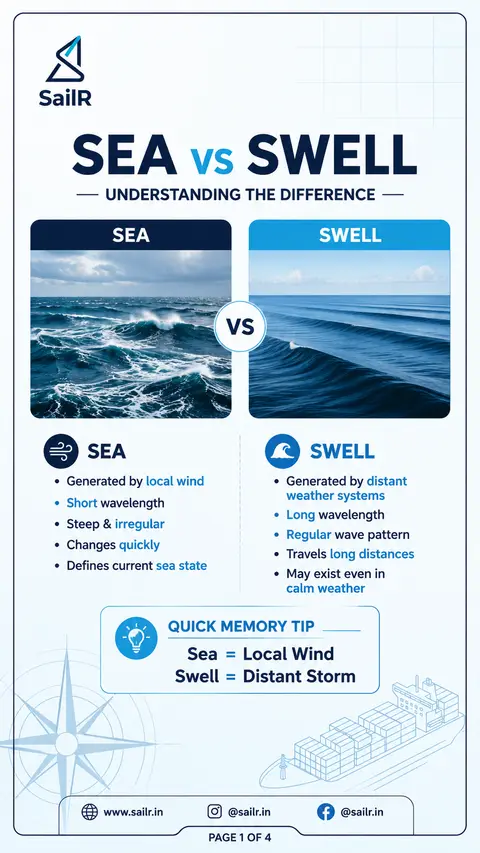
Slide 1 · SEA vs SWELL
SEA vs SWELL
UNDERSTANDING THE DIFFERENCE
SEA
SWELL
SEA
Generated by local wind
Short wavelength
Steep & irregular
Changes quickly
Defines current sea state
SWELL
Generated by distant weather systems
Long wavelength
Regular wave pattern
Travels long distances
May exist even in calm weather
QUICK MEMORY TIP
Sea = Local Wind
Swell = Distant Storm
Slide 2 · MIST vs FOG
MIST vs FOG
IT'S ALL ABOUT VISIBILITY
MIST
FOG
VS
Visibility
> 1000 metres
(> 0.5 NM)
Cause
Fine water droplets
suspended in air
Navigation
Possible with
caution
Visibility
< 1000 metres
(< 0.5 NM)
Cause
Dense suspended
water droplets
Navigation
Restricted visibility
procedures apply
FOG CHECKLIST
Safe Speed
(COLREG
Rule 6)
Sound Fog Signals
(Rule 35)
1 prolonged blast
every ≤ 2 min
Maintain
Proper
Lookout
Use Radar
& AIS
Follow
Rule 19
Slide 3 · COASTAL WEATHER
COASTAL WEATHER
BULLETIN STRUCTURE
THREE PARTS. ONE PURPOSE – SAFE VOYAGE.
PART I
WARNINGS
• Gale Warnings
• Storm Warnings
• Tropical Cyclone Warnings
• Other significant weather warnings issued by the Meteorological Service
↓
PART II
SYNOPSIS
• Position of Highs & Lows
• Central Pressure
• Fronts (Warm / Cold / Occluded)
• Movement & Development of Pressure Systems
• Associated Wave Conditions (if significant)
↓
PART III
FORECAST
• Wind (Direction & Speed)
• Weather
• Visibility (if < 5 NM)
• Sea State (Wave Height & Total Sea State)
• Ice Accretion (if applicable)
• Outlook (Next 24 hours or more)
Essential information for planning, monitoring and safe navigation at sea.
Slide 4 · QUICK REVISION
QUICK REVISION
KEY POINTS TO REMEMBER
1. SEA vs SWELL
SEA
SWELL
VS
Generated by local wind
Short wavelength
Steep & irregular
Changes quickly
Defines current sea state
Generated by distant weather systems
Long wavelength
Regular wave pattern
Travels long distances
May exist even in calm weather
2. MIST vs FOG
MIST
FOG
Visibility > 1000 metres (> 0.5 NM)
Fine water droplets suspended in air
Navigation possible with caution
Visibility < 1000 metres (< 0.5 NM)
Dense suspended water droplets
Restricted visibility procedures apply
3. COASTAL WEATHER BULLETIN STRUCTURE
PART I WARNINGS
PART II SYNOPSIS
PART III FORECAST
Gale Warnings
Storm Warnings
Tropical Cyclone Warnings
Other significant weather warnings issued by the Meteorological Service
Position of Highs & Lows
Central Pressure
Fronts (Warm / Cold / Occluded)
Movement & Development of Pressure Systems
Associated Wave Conditions (if significant)
Wind (Direction & Speed)
Weather
Visibility (if < 5 NM)
Sea State (Wave Height & Total Sea State)
Ice Accretion (if applicable)
Outlook (Next 24 hours or more)
Essential information for voyage planning, monitoring and safe navigation.
4. COLREGS REMEMBER
RULE 6
Safe Speed
Proceed at a safe speed appropriate to the prevailing circumstances.
RULE 19
Restricted Visibility
Appropriate precautions and navigation rules apply in fog, mist, etc.
RULE 35
Fog Signals
One prolonged blast at intervals not exceeding 2 minutes for power-driven vessels making way.
Drafted by SailR from our daily lessons. AI-drawn illustration. Simplified to explain the idea, not to scale. Last updated 19 Oct 2026.
Spotted a mistake?