The slides, written out
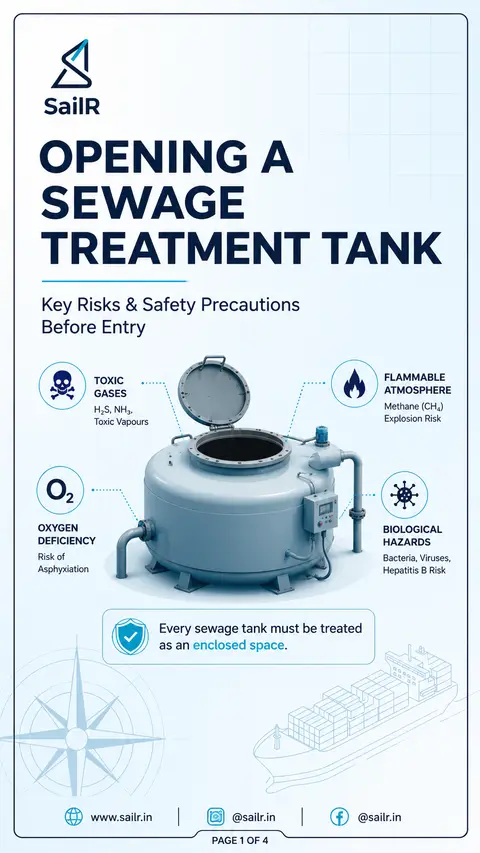
AI-drawn illustration. Simplified to explain the idea, not to scale.
Slide 1 · OPENING A
OPENING A
SEWAGE
TREATMENT TANK
Key Risks & Safety Precautions
Before Entry
TOXIC
GASES
H2S, NH3,
Toxic Vapours
FLAMMABLE
ATMOSPHERE
Methane (CH4)
Explosion Risk
O2
OXYGEN
DEFICIENCY
Risk of
Asphyxiation
BIOLOGICAL
HAZARDS
Bacteria, Viruses,
Hepatitis B Risk
Every sewage tank must be treated
as an enclosed space.
Slide 2 · WHAT CAN
WHAT CAN
GO WRONG?
Risks waiting inside the sewage tank
TOXIC GASES
Hydrogen Sulphide (H2S)
Methane (CH4)
Ammonia (NH3)
H2S is the most hazardous. Occupational alarms are typically set around 10 ppm.
FLAMMABLE ATMOSPHERE
Methane (CH4) is highly flammable, lighter than air.
Can accumulate in upper sections and may displace oxygen.
O2
OXYGEN DEFICIENCY
Anaerobic conditions use up oxygen.
No warning odour.
BIOLOGICAL HAZARDS
Contains bacteria (coliforms, salmonella)
Viruses, especially Hepatitis B
Can enter through cuts or aerosols
CONFINED SPACE
Limited entry/exit, risk of entrapment, collapse of fittings or drowning.
CHEMICAL HAZARDS
Residual cleaning agents or biocides may react with sewage to form toxic gases.
UNPREDICTABLE CONDITIONS
Gas concentration can change rapidly without any warning.
NOT JUST A TANK.
IT'S A POTENTIAL GAS CHAMBER.
Slide 3 · BEFORE OPENING
BEFORE OPENING
THE TANK
Follow this sequence. Don't rush. Don't skip.
1
ISOLATE THE SYSTEM
• Stop the system.
• Close all inlet and outlet valves.
2
EMPTY THE TANK
• Pump out the tank completely.
• Remove all sludge and liquid.
3
FLUSH THOROUGHLY
• Flush with clean seawater (or fresh water).
• Repeat until discharge runs clear.
4
VENTILATE
• Use an explosion-proof blower to ventilate.
• Minimum 30 minutes before testing.
5
GAS TEST
• Test at top, middle and bottom.
• Ensure safe atmosphere before entry.
6
PERMIT TO WORK
• Enclosed Space Entry Permit must be issued.
• Approved by Master / Chief Engineer.
If the atmosphere is not safe,
DO NOT OPEN. DO NOT ENTER.
Ventilate and test again.
ATMOSPHERE MUST BE VERIFIED
O2 OXYGEN 19.5% – 23.5%
H2S HYDROGEN SULPHIDE (H2S) Check & ensure safe level
LEL LOWER EXPLOSIVE LIMIT (LEL) Below 10% LEL
CO CARBON MONOXIDE (CO) Check & ensure safe level
USE A CALIBRATED MULTI-GAS DETECTOR
Test at different levels. Gases can stratify.
Slide 4 · SAFE ENTRY & REPAIR
SAFE ENTRY & REPAIR
Work smart. Work safe. Come back safe.
DURING ENTRY AND WORK
STAND-BY PERSON
A dedicated person must stay outside at all times.
Maintain constant communication.
FULL BODY HARNESS & LIFELINE
Wear a full body harness.
Lifeline should be held by the standby person at all times.
CONTINUOUS COMMUNICATION
Use radio, visual signals or line-pull system.
Never work alone.
CONTINUOUS GAS MONITORING
Use a multi-gas detector inside the tank.
If alarm sounds, EVACUATE IMMEDIATELY.
VENTILATION MAINTAINED
Keep forced ventilation running during the job.
Ensure fresh air circulation.
EXPLOSION-PROOF LIGHTING & TOOLS
Use only explosion-proof lights.
Use pneumatic or intrinsically safe tools.
EVACUATE ON ALARM
Do not ignore any alarm.
Exit immediately and inform standby person.
DECONTAMINATE AFTER WORK
Clean all tools and equipment.
Decontaminate PPE before removal.
AFTER THE WORK
CLEAN UP
Hose down PPE and tools before removal.
WASH UP
Wash hands, face and forearms thoroughly.
RESTART SYSTEM
Follow manufacturer's procedure to refill, aerate and restart.
VERIFY OPERATION PERFORMANCE
Follow manufacturer's recommissioning procedure and verify normal performance.
NO PERMIT. NO GAS TEST. NO ENTRY.
SAFETY IS NOT OPTIONAL.
Drafted by SailR from our daily lessons. AI-drawn illustration. Simplified to explain the idea, not to scale. Last updated 19 Oct 2026.
Spotted a mistake?