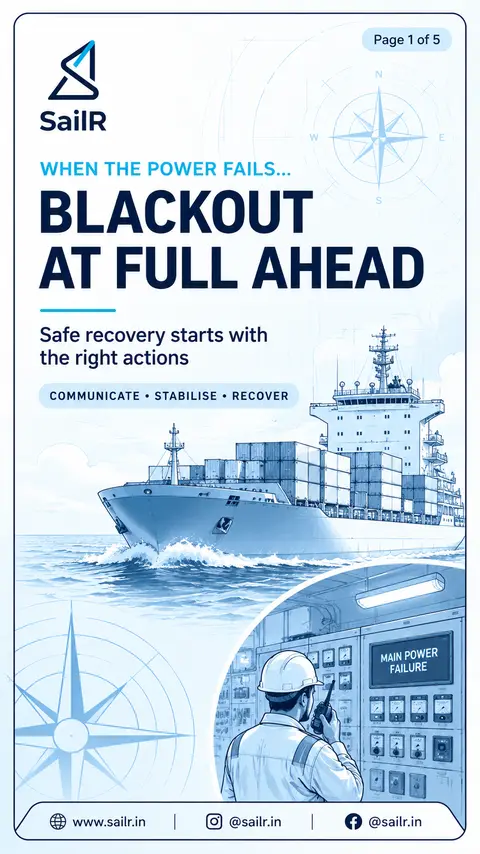
Ship Blackout at Full Ahead: Immediate Actions, Power Restoration and Propulsion Recovery
- MEO Class 1
- Chief Mate
- MEO Class 4
- times asked
- 9
- times asked
- questions
- 4
- questions
- last asked
- 2026
- last asked
A blackout at full-ahead speed can affect essential electrical services and the ship’s ability to manoeuvre. The bridge and engine room must communicate clearly, restore power in the approved sequence and confirm that propulsion is ready before normal operation resumes. These notes explain the immediate response, safe electrical recovery, main-engine restart considerations and measures that help prevent another blackout.
The slides, written out
AI-drawn illustration. Simplified to explain the idea, not to scale.
Slide 1 · A blackout at full-ahead speed is a loss-of-control and personnel-safety emergency
A blackout at full-ahead speed is a loss-of-control and personnel-safety emergency. The bridge must be informed promptly about the failure and the available propulsion, steering and emergency electrical supply. Recovery must follow the ship’s approved blackout and dead-ship procedures. Communicate early, protect people and restore propulsion only when the required conditions are satisfied.
Slide 2 · Inform the bridge immediately and confirm the status of propulsion, steering and emerge…
Inform the bridge immediately and confirm the status of propulsion, steering and emergency power. Activate the engineer’s call as required by the ship’s procedure, organise the response team and assign clear communication duties. Confirm that the emergency generator has started and connected as intended. Protect personnel from electrical hazards and machinery that may restart automatically. Use emergency lighting and verify that essential emergency services are functioning.
Slide 3 · Restore electrical power in a controlled and approved sequence
Restore electrical power in a controlled and approved sequence. Confirm the emergency supply and the generating capacity available before reconnecting essential loads. Avoid connecting loads indiscriminately because excessive demand can overload the available supply. If normal recovery fails, follow the ship’s approved dead-ship starting procedure rather than improvising a sequence from memory.
Slide 4 · Power restoration does not automatically mean that propulsion is ready
Power restoration does not automatically mean that propulsion is ready. Verify the machinery services required for a safe main-engine restart, including lubricating-oil, cooling-water and fuel-oil systems where applicable. Investigate the cause of the shutdown and electrical trips before resetting and restarting affected equipment. Follow the approved machinery procedure, then confirm propulsion availability to the bridge and monitor the machinery after restart.
Slide 5 · Preventing another blackout depends on reliable equipment, clear procedures and a train…
Preventing another blackout depends on reliable equipment, clear procedures and a trained team. Maintain and test the emergency generator and its automatic starting arrangements at the required intervals. Keep the ship-specific blackout and dead-ship procedures current and accessible. Practise recovery drills, investigate recurring alarms and trips, and complete corrective actions. Include newly joining engineers in practical familiarisation with critical emergency equipment.
What it is
A blackout at full-ahead speed is a failure of the main electrical supply that can interrupt essential electrical services and affect the ship’s ability to manoeuvre. The emergency generator may provide specified emergency services, but its availability does not establish that normal propulsion power has been restored. The first task is to establish the extent of the failure and communicate the actual condition of the ship. (SOLAS II-1/43.2–43.3)
The bridge and engine room have different immediate responsibilities during the event. The bridge must manage the ship’s navigation and traffic situation, while the engineering team establishes which electrical and machinery services remain available. Clear reports help the bridge understand the situation without relying on assumptions about when propulsion will return. The recovery must follow the vessel’s approved procedures and the machinery instructions applicable to the installed plant. (SOLAS II-1/43.2; ISM Code 8.1)
Why it matters
Loss of electrical power can affect services required for the safe operation of the ship. The emergency electrical source is intended to supply the services specified by the applicable requirements. It is not a substitute for the main electrical supply in every operating condition, and it does not guarantee that every propulsion auxiliary will be available. Officers must distinguish between emergency services that are operating and the equipment still required to restore normal propulsion. (SOLAS II-1/43.2–43.3)
An uncontrolled attempt to restore loads can create further difficulties if the available generating capacity is exceeded. The restoration sequence must therefore account for the services that are required and the capacity available from the electrical supply. The engineering team should verify the actual condition of the system before reconnecting additional loads. (SOLAS II-1/43.2 and 43.5.5)
How it works on board
The first action is to inform the bridge that the main electrical supply has failed. Report the known status of propulsion, steering and emergency power, and continue communicating as the condition changes. Activate the engineer’s call and organise the engineering response in accordance with the ship’s procedures. Assigning clear responsibilities helps prevent important reports or instructions from being missed. (SOLAS II-1/43.2; ISM Code 8.1)
Next, establish whether the emergency generator has started and connected as intended. Where the automatic starting arrangement has failed, follow the approved procedure for manual action. The emergency generator and its starting arrangements must comply with the applicable requirements. Once the emergency supply is available, confirm which essential services are functioning before attempting to restore further loads. (SOLAS II-1/43.3.1.2 and 43.7)
Restore the required electrical loads in the approved sequence. Do not assume that every motor or auxiliary can be started together. The available supply must be capable of meeting the demand, and the actual starting arrangement must be considered. If the normal recovery sequence fails, use the ship’s approved dead-ship procedure. A generic sequence should not replace the instructions for the installed machinery. (SOLAS II-1/43.2 and 43.5.5)
Before restarting the main engine, verify the supporting services required by its machinery instructions. These may include lubricating-oil pumps, cooling-water systems and fuel-oil equipment, depending on the installation. If the engine has shut down, investigate the initiating fault and check for evidence of damage or unsafe conditions. Do not reset a trip and restart solely to regain propulsion without understanding the fault. (SOLAS II-1/41.1.4 and 45)
When the required conditions have been satisfied, follow the approved engine restart procedure. Confirm that the engine is operating normally and that propulsion is available before reporting readiness to the bridge. Continue monitoring the machinery for abnormal indications after the restart. The bridge must receive an accurate status report rather than an assumption that the ship is ready because electrical power has returned. (SOLAS II-1/41.1.4; ISM Code 8.1)
The rules
The following requirements and controls are relevant to blackout recovery:
SOLAS II-1/41.1.4 addresses electrical capacity associated with starting propulsion from a dead-ship condition. Apply the provision according to the ship’s applicable requirements. (SOLAS II-1/41.1.4)
SOLAS II-1/43 specifies requirements for emergency electrical power, including emergency services and starting arrangements. The emergency generator and its automatic starting arrangements must be maintained and tested as required. (SOLAS II-1/43.2, 43.3.1.2 and 43.7)
SOLAS II-1/43.3.4 contains a 30-minute provision for restoring propulsion under specified conditions. It applies to the relevant ships constructed on or after 1 July 1998 where electrical power is necessary to restore propulsion. Do not treat it as a universal deadline for every ship or every blackout. (SOLAS II-1/43.3.4)
SOLAS II-1/45 addresses precautions against electrical shock, fire and other electrical hazards. Personnel must follow the applicable precautions when inspecting or working on electrical equipment. (SOLAS II-1/45)
The ISM Code requires the company to identify potential emergencies, establish response procedures and maintain shipboard equipment through appropriate arrangements. Blackout procedures, drills and maintenance should support these obligations. (ISM Code 8.1 and 10.1–10.2)
Common mistakes
Treating the emergency generator as proof that normal propulsion can be restored is a mistake. Emergency electrical power supplies specified services, while propulsion recovery may require additional machinery and electrical capacity. Confirm the condition of the required services before declaring the ship ready. (SOLAS II-1/41.1.4 and 43.2–43.3)
Another mistake is connecting loads without considering the available generating capacity. Restore services in the approved sequence and check that the electrical supply remains stable. If the normal sequence fails, use the ship’s dead-ship procedure rather than improvising steps from memory. (SOLAS II-1/43.2 and 43.5.5)
Resetting a trip without investigating its cause can leave the original fault unresolved. Check the relevant alarms and indications, investigate the failure and follow the machinery-specific instructions before attempting to return affected equipment to service. Record findings in accordance with the ship’s safety and maintenance procedures. (SOLAS II-1/45; ISM Code 10.1–10.2)
Finally, an emergency procedure that exists only on paper may not provide an effective response. Keep procedures accessible, test emergency arrangements at the required intervals and conduct drills that exercise communication and recovery responsibilities. Review deficiencies after drills and real events, then verify that corrective actions have been completed. (SOLAS II-1/43.7; ISM Code 8.1 and 10.1–10.2)
In exams
Asked 9 times across 4 different questions, most recently in 2026. Asked most in MEO Class 1 (6), Chief Mate (2), MEO Class 4 (1).
Drafted by SailR from the regulations cited. AI-drawn illustration. Simplified to explain the idea, not to scale. Last updated 29 Oct 2026.
Spotted a mistake?