The slides, written out
AI-drawn illustration. Simplified to explain the idea, not to scale.
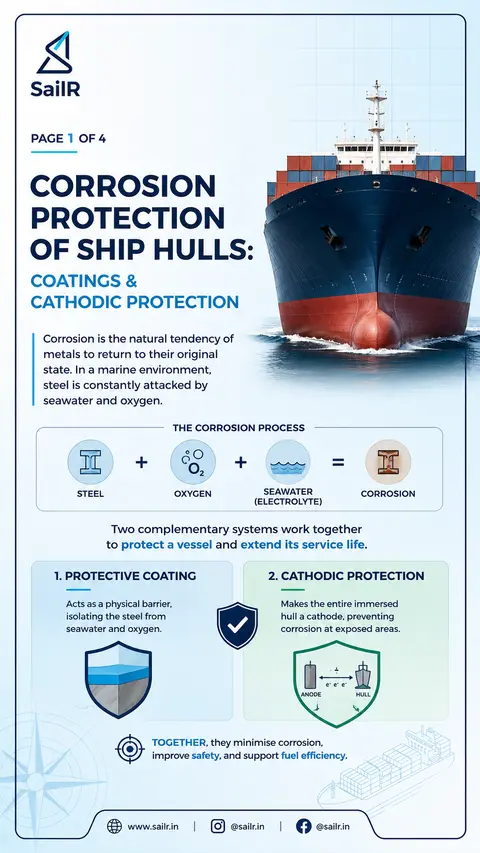
Slide 1 · CORROSION
CORROSION
PROTECTION
OF SHIP HULLS:
COATINGS &
CATHODIC PROTECTION
Corrosion is the natural tendency of
metals to return to their original
state. In a marine environment,
steel is constantly attacked by
seawater and oxygen.
THE CORROSION PROCESS
STEEL
+
OXYGEN
+
SEAWATER
(ELECTROLYTE)
=
CORROSION
Two complementary systems work together
to protect a vessel and extend its service life.
1. PROTECTIVE COATING
Acts as a physical barrier,
isolating the steel from
seawater and oxygen.
2. CATHODIC PROTECTION
Makes the entire immersed
hull a cathode, preventing
corrosion at exposed areas.
ANODE
HULL
e- e- e-
TOGETHER, they minimise corrosion,
improve safety, and support fuel efficiency.
Slide 2 · PROTECTIVE COATINGS
PROTECTIVE COATINGS:
PRIMARY LINE OF DEFENCE
The coating system acts as a physical barrier, isolating the steel from seawater and oxygen. Proper surface preparation and the right coating system are essential for long-term performance and fuel efficiency.
WHY IT MATTERS
• Prevents corrosion
• Improves coating life
• Reduces maintenance costs
• Supports lower fuel consumption
• Ensures compliance with IMO standards (PSPC)
THE COATING SYSTEM (OUTSIDE HULL)
1. SURFACE PREPARATION
Abrasive blasting to Sa 2½ (near-white metal) cleanliness removes rust, mill scale and old coatings, creating an ideal anchor profile.
2. EPOXY PRIMER
High-quality epoxy primer is applied immediately after blasting for strong adhesion and corrosion resistance.
3. SPC TOPCOAT
Self-Polishing Copolymer (SPC) coatings gradually hydrolyse during service, continuously exposing a smoother surface that helps maintain lower hydrodynamic resistance.
4. SMOOTH HULL = LOWER RESISTANCE
A well-maintained coating system reduces frictional resistance and supports better fuel efficiency.
BALLAST TANK COATINGS (INSIDE TANKS)
Ballast tanks are exposed to severe wet/dry cycles and oxygen. A hard epoxy coating system applied over Sa 2½ surface preparation provides robust protection and prevents pitting corrosion.
KEY TAKEAWAY FOR THE CHIEF OFFICER
Coating is not a 'set and forget' system. It requires proper specification, quality application and planned maintenance for maximum protection.
| |
Slide 3 · Cathodic protection is the secondary
Cathodic protection is the secondary
line of defence. It protects the steel
where the coating is damaged or
ineffective by making the entire
immersed hull a cathode.
CATHODIC PROTECTION SYSTEMS:
SECONDARY LINE OF DEFENCE
1. SACRIFICIAL ANODE
(GALVANIC) SYSTEM
A less noble metal corrodes in preference
to the steel, protecting the hull.
e- e- e-
ANODE
(corrodes)
STEEL HULL
(protected)
2. IMPRESSED CURRENT
CATHODIC PROTECTION (ICCP) SYSTEM
Using the ship's power, the system supplies a
controlled DC current to inert anodes.
ICCP
CONTROLLER
REFERENCE
ELECTRODE
(Ag/AgCl)
WHERE USED
Hull: stern frame, rudder, bilge keels,
propeller & shaft protection
Inside ballast tanks
HOW IT WORKS
Zinc or aluminium anodes are directly
connected to the hull. They "sacrifice"
themselves, supplying electrons to the
steel and preventing corrosion.
PRACTICAL POINTS
Anodes are consumable and must be
inspected regularly (diver's report).
Replace before fully wasted.
Protects against galvanic coupling
(e.g., bronze propeller vs. steel hull).
IN BALLAST TANKS
Some systems use higher-output anodes
initially to assist formation of the calcareous
protective layer, followed by lower-output
anodes intended for long-term protection.
HOW IT WORKS
Inert anodes (usually platinised titanium) are
permanently mounted on the hull. A reference
electrode measures hull potential, and the
ICCP controller automatically adjusts current
to maintain the protective potential.
TYPICAL PROTECTION POTENTIAL
Maintains hull potential at approximately
−0.80 V to −0.85 V (Ag/AgCl).
ADVANTAGES
Provides higher protection capability
Effective even with coating damage
Anodes do not waste away
Continuous, automatic monitoring & control
PRACTICAL POINTS FOR THE CHIEF OFFICER
Monitor ammeter and voltmeter in the ECR or
steering gear room.
An increase in current demand often indicates
coating deterioration or damage.
COMPARISON AT A GLANCE
Uses zinc/aluminium anodes | Uses inert anodes (titanium)
Anodes corrode and need replacement | Anodes do not corrode
Lower current output | Higher current output
Simple, passive system | Active, power-driven system
Suitable for small to medium vessels | Typical on large, modern vessels
BARRIER PROTECTION
+ CATHODIC PROTECTION
=
LONG-TERM CORROSION
CONTROL
No single system is perfect.
A good coating reduces the workload on CP,
and CP protects the areas where coating fails.
| |
Slide 4 · PROTECTING
PROTECTING
A SHIP'S HULL
AGAINST CORROSION
Protective Coatings &
Cathodic Protection Explained
PROTECTIVE
COATINGS
CATHODIC
PROTECTION
KEY TAKEAWAY
Two complementary systems protect
a ship's steel hull:
Protective Coatings (Primary Defence)
Cathodic Protection (Secondary Defence)
@saillr.in
Drafted by SailR from our daily lessons. AI-drawn illustration. Simplified to explain the idea, not to scale. Last updated 19 Oct 2026.
Spotted a mistake?