The slides, written out
AI-drawn illustration. Simplified to explain the idea, not to scale.
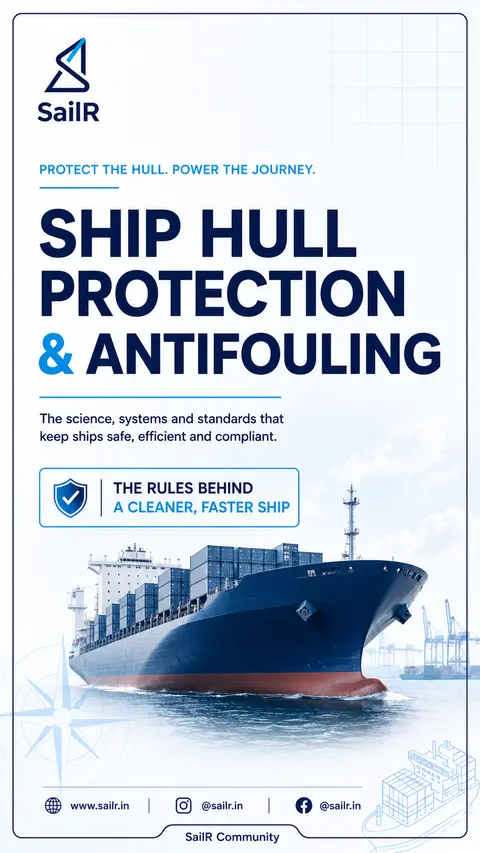
Slide 1 · PROTECT THE HULL
PROTECT THE HULL. POWER THE JOURNEY.
SHIP HULL
PROTECTION
& ANTIFOULING
The science, systems and standards that
keep ships safe, efficient and compliant.
THE RULES BEHIND
A CLEANER, FASTER SHIP
| |
Slide 2 · HOW A SHIP'S
HOW A SHIP'S
HULL IS PROTECTED
Corrosion protection + fouling control
work together.
01
COATING SYSTEM
Primer and protective coats create
a barrier between steel and
seawater.
02
CATHODIC PROTECTION
Where an approved system is fitted,
sacrificial anodes protect exposed
or immersed metal by preferential
corrosion of the anode.
03
SURFACE PREPARATION
Coating performance depends
heavily on proper surface
preparation, cleanliness, profile
and application.
Sa 2½
Sa 2½ is a specified preparation standard
for important marine coating applications.
Under IMO PSPC requirements for dedicated
seawater ballast tanks, Sa 2½ and a
30–75 μm surface profile are specified.
GOOD STEEL PREPARATION → GOOD COATING ADHESION → LONGER PROTECTION
| |
Slide 3 · STOP FOULING
STOP FOULING. SAVE FUEL. PROTECT THE OCEAN.
TYPES OF
ANTIFOULING
COATINGS
How antifouling systems control marine growth.
01
CONTROLLED DEPLETION
POLYMER (CDP)
Traditional biocidal antifouling
systems release active biocide
from the coating to control
fouling.
02
SELF POLISHING
COPOLYMER (SPC)
The coating undergoes controlled
chemical/physical erosion,
continually exposing fresh
active material.
i Self polishing does NOT require
ship movement to occur.
03
FOUL RELEASE
Biocide-free, low-adhesion surfaces
make it difficult for organisms to
attach firmly.
i Fouling release is influenced by
the coating properties and vessel
operating conditions.
KEY TAKEAWAY
Antifouling technology ≠ one coating type.
| |
Slide 4 · WHAT IS
WHAT IS
ACTUALLY BANNED?
AFS CONVENTION: WHAT SHIPS MUST CONTROL
TBT / ORGANOTIN COMPOUNDS
The AFS Convention prohibits the application or reapplication of organotin compounds acting as biocides in anti-fouling systems.
WHY TBT WAS CONTROLLED
TBT was found to cause severe effects in marine organisms, including oyster shell deformities and reproductive abnormalities in gastropods. Its persistence and bioaccumulation create serious environmental concerns and it can enter the food chain.
BUT IT IS NOT "ALL TOXIC ANTIFOULING"
The Convention controls specified harmful substances rather than banning every biocidal antifouling system. Approved biocidal antifouling systems that comply with the Convention continue to exist.
CYBUTRYNE – CURRENT CONTROL
IMO amendments introduced controls on cybutryne. From 1 January 2023, ships may no longer apply or reapply antifouling systems containing cybutryne, subject to the Convention's transitional requirements.
1 JAN 2023
✓ AFS Convention adopted: 5 October 2001
✓ Entered into force: 17 September 2008
✓ TBT controlled → Cybutryne controlled
✓ Mechanism exists to control future harmful substances
KEY TAKEAWAY
TBT controlled → Cybutryne controlled → Mechanism exists for future substances.
Slide 5 · DECK vs
DECK vs
SUPERSTRUCTURE
Same ship. Different coating requirements.
DECK COATING
High mechanical exposure
Abrasion resistance
Impact resistance
Seawater / corrosion resistance
Non-skid performance where required
UV / weather resistance
SUPERSTRUCTURE COATING
Greater atmospheric exposure
Weather resistance
Colour & gloss retention
Corrosion protection
Smooth decorative finish where specified
UV / weather resistance
DECK
Think:
TOUGHNESS + SAFETY + CORROSION PROTECTION
Deck areas experience foot traffic, cargo operations, equipment movement, abrasion and seawater exposure.
SUPERSTRUCTURE
Think:
WEATHERING + APPEARANCE + CORROSION PROTECTION
Superstructure coating systems must withstand atmospheric marine exposure while maintaining appearance and colour performance.
IMPORTANT CORRECTION
Do not assume superstructure corrosion is always "less severe" than deck corrosion. Actual coating requirements depend on the location, exposure, design and specification.
KEY TAKEAWAY:
Different exposure → Different coating specification.
Drafted by SailR from our daily lessons. AI-drawn illustration. Simplified to explain the idea, not to scale. Last updated 19 Oct 2026.
Spotted a mistake?