The slides, written out
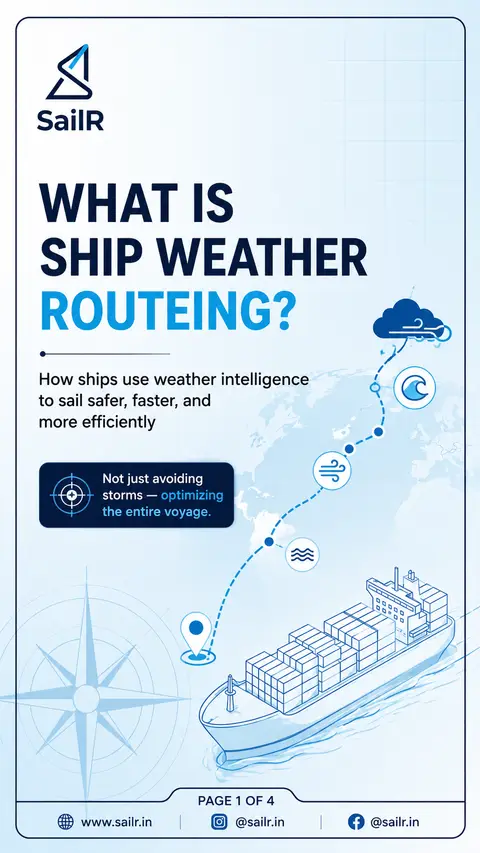
AI-drawn illustration. Simplified to explain the idea, not to scale.
Slide 1 · WHAT IS
WHAT IS
SHIP WEATHER
ROUTEING?
How ships use weather intelligence
to sail safer, faster, and
more efficiently
Not just avoiding
storms — optimizing
the entire voyage.
Slide 2 · OBJECTIVES OF
OBJECTIVES OF
WEATHER ROUTEING
Weather Routeing helps ships make better
decisions for a safer and more efficient voyage.
1. SAFETY
Avoid areas of heavy weather,
tropical cyclones, ice, fog, and other
hazards that could endanger the
ship, crew, or cargo.
2. FUEL ECONOMY
Minimise added resistance from
head winds, waves, and adverse
currents so the engine works less
and burn rate drops.
3. SCHEDULE RELIABILITY
Achieve the required time of
arrival with fewer delays from
weather-related speed reductions.
4. CARGO INTEGRITY
Reduce slamming, rolling, and
shipping of green water that can
damage deck cargo, containers,
or sensitive stowage.
5. MINIMISE STRUCTURAL FATIGUE
Avoid prolonged exposure to heavy
seas that can stress hull and
superstructure.
6. CREW WELFARE
Less violent motion means better
rest, fewer injuries, and higher
morale — something that pays
long-term dividends.
SAFER VOYAGE. LOWER COSTS. BETTER PERFORMANCE.
Slide 3 · THE WEATHER
THE WEATHER
ROUTEING PROCESS
A continuous cycle of planning, monitoring,
and optimisation for every voyage.
1
PRE-VOYAGE PLANNING
Analyse forecast weather and ocean data
Review ship performance and limitations
Evaluate route options and constraints
Develop optimum route and speed plan
Goal: Safe & efficient
route before departure
2
ROUTE RECOMMENDATION
Routeing service sends recommended
track, waypoints, and expected conditions
Master reviews with own appraisal
and decides to accept, modify,
or delay departure
Goal: Best plan agreed
before sailing
3
VOYAGE MONITORING
Ship reports position, weather
observations & speed
Routeing service compares actual
performance with forecast
Two-way feedback improves accuracy
Goal: Stay informed,
stay on track
4
ROUTE ADJUSTMENT
Receive updated forecasts and advisories
Adjust course or speed to avoid
deteriorating conditions
Take storm evasion action when necessary
Goal: Avoid hazards,
minimise impact
5
POST-VOYAGE ANALYSIS
Compare planned vs actual track
Review fuel consumption
and weather encountered
Refine ship performance data for
better future recommendations
Goal: Learn, improve,
optimise future voyages
Better data. Smarter decisions. Safer voyages.
Slide 4 · REAL-WORLD BENEFITS
REAL-WORLD BENEFITS
OF WEATHER ROUTEING
Smart routeing decisions lead to safer voyages,
lower costs, and better overall performance.
REDUCED FUEL
CONSUMPTION
Avoid adverse winds,
waves, and currents
to burn less fuel and
save more.
REDUCED STRUCTURAL
FATIGUE
Limit exposure to heavy
seas and high loads,
protecting the hull and
superstructure.
IMPROVED SCHEDULE
ADHERENCE
Better ETA reliability
with fewer delays
caused by weather.
BETTER CREW
COMFORT
Smoother voyages mean
better rest, fewer injuries,
and higher morale.
LOWER WEATHER-
RELATED RISK
Proactively avoid severe
weather, storms, ice,
fog, and other hazards.
IMPROVED VOYAGE
EFFICIENCY
Optimised speed and route
choices for the best balance
of time and cost.
ENHANCED CARGO
PROTECTION
Reduce slamming, rolling,
and green water to protect
cargo and containers.
DATA-DRIVEN
DECISIONS
Continuous feedback
improves performance
and future routeing quality.
Every route is a balance between
safety, efficiency, and performance.
Follow for more
practical maritime knowledge.
Visit
Drafted by SailR from our daily lessons. AI-drawn illustration. Simplified to explain the idea, not to scale. Last updated 19 Oct 2026.
Spotted a mistake?