The slides, written out
AI-drawn illustration. Simplified to explain the idea, not to scale.
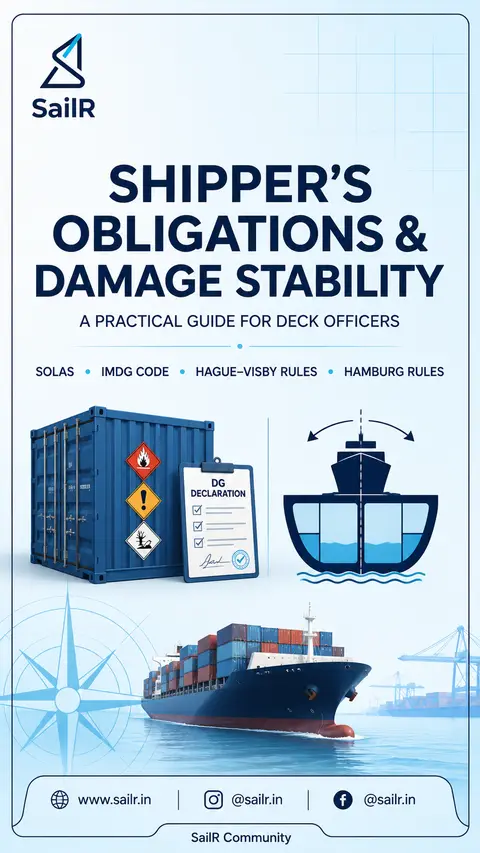
Slide 1 · SHIPPER'S
SHIPPER'S
OBLIGATIONS &
DAMAGE STABILITY
A PRACTICAL GUIDE FOR DECK OFFICERS
SOLAS • IMDG CODE • HAGUE–VISBY RULES • HAMBURG RULES
DG DECLARATION
| |
Slide 2 · SHIPPER'S OBLIGATIONS
SHIPPER'S OBLIGATIONS
FOR IMDG CARGOES
SOLAS Chapter VII • IMDG Code Requirements
01
ACCURATE TRANSPORT
INFORMATION
Proper Shipping Name
(PSN)
UN Number
Class
Packing Group
Subsidiary Risks
Marine Pollutant
(Where applicable)
02
DANGEROUS GOODS
DOCUMENTATION
Dangerous Goods
Transport Document
(DG Declaration)
Container/Vehicle
Packing Certificate
(certifying compliance
with IMDG Code)
No valid documentation =
No acceptance for carriage
03
MARKING, LABELLING
& PACKAGING
Packages must be
properly marked,
labeled and
placarded
Use approved
packaging
Compliance with
IMDG Code
requirements
04
EMERGENCY
PREPAREDNESS ONBOARD
The vessel uses:
Emergency
Response
Procedures for
Ships Carrying
Dangerous
Goods (EmS Guide)
Medical First Aid
Guide (MFAG)
Both referenced within
the IMDG Code to respond
to emergencies
KEY PRINCIPLE
"NO COMPLIANT DECLARATION = NO CARRIAGE."
Slide 3 · LEGAL RESPONSIBILITIES
LEGAL RESPONSIBILITIES
OF THE SHIPPER
HAGUE–VISBY RULES • HAMBURG RULES
HAGUE–VISBY RULES
1. ACCURACY GUARANTEED
The shipper guarantees the accuracy of marks, numbers, quantity and weight furnished at the time of shipment.
2. INCORRECT PARTICULARS
Shipper is liable for loss or damage resulting from incorrect or insufficient particulars supplied.
3. DANGEROUS GOODS LIABILITY
If dangerous goods are shipped without the carrier's knowledge and consent, the shipper is strictly liable for all damages and expenses.
4. CARRIER'S RIGHTS
Carrier may discharge, destroy or render harmless the dangerous goods and is entitled to recover all costs.
5. FAULT–BASED LIABILITY
Shipper is liable for loss or damage caused by his act, fault or neglect (e.g., improper packing, instructions, or stowage in container).
HAMBURG RULES
1. DUTY TO INFORM
The shipper must inform the carrier of the dangerous nature of the goods before shipment.
2. DANGEROUS GOODS NOTIFICATION
Failure to notify the carrier of dangerous goods may result in liability for all resulting losses.
3. INCORRECT DESCRIPTION
Liability arises for loss or damage caused by incorrect description or particulars of the goods.
4. SHIPPER LIABILITY
The shipper is liable for loss, damage and expenses arising from the shipment of dangerous goods without proper disclosure.
PRACTICAL ADVICE FOR OFFICERS
Compare DG declaration with container placards and labels.
Inspect container condition for leakage, damage or suspicion.
Verify dangerous goods stowage plan and segregation requirements.
If in doubt, ask for clarification or re-declaration.
Reject or refuse suspicious or non-compliant containers.
YOUR DEFENCE ON BOARD IS
PROPER ACCEPTANCE PROCEDURES, INSPECTION & MAINTAINING A CORRECT STOWAGE PLAN.
Slide 4 · THE MASTER'S RESOURCES
THE MASTER'S RESOURCES
IN ASCERTAINING
DAMAGE STABILITY
TOOLS • DOCUMENTATION • DECISION SUPPORT
01 DAMAGE CONTROL BOOKLET
• Contains pre-calculated damage stability cases for survivability.
• Flooding diagrams and cross-flooding arrangements.
• Residual stability data (GM, GZ curves, heel angles, etc.).
• Instructions for doors, bilge systems and emergency actions.
02 APPROVED LOADING COMPUTER
• Perform damage stability calculations by simulating flooded compartments.
• Provides rapid "what if" analysis for emergency decisions.
• Must be kept updated with current draft, trim and GM.
03 STABILITY & TRIM BOOKLET
• Contains hydrostatic data and intact stability criteria.
• Limiting KG curves for the loaded condition.
• Starting point for assessing the ship's condition after damage.
04 DECISION SUPPORT TOOLS (WHERE FITTED)
• Onboard software to assist the Master during flooding emergencies.
• Recommends actions, shows possible flooding scenarios and predicted ship response.
• Helps assess residual stability and maximum permissible heel.
05 SHIPBUILDER'S APPROVED STABILITY INFORMATION
• Includes the Flooding Standard and approved damage cases.
• Based on class-approved damage stability calculations.
• Keep readily available for quick reference.
06 EMERGENCY RESPONSE ACTIONS
• Establish the extent of damage (flooded compartments).
• Consult booklet / loading computer for closest survival case.
• Involve Chief Engineer for machinery spaces and bilge/ballast systems.
DAMAGE STABILITY ASSESSMENT PROCESS
1. COLLISION / GROUNDING
2. ASSESS FLOODING
3. STABILITY CALCULATION
4. RESIDUAL STABILITY
5. CORRECTIVE ACTION
The Master's most valuable resource is a thorough understanding of the vessel's approved damage stability information and the ability to apply it rapidly during an emergency.
| |
Drafted by SailR from our daily lessons. AI-drawn illustration. Simplified to explain the idea, not to scale. Last updated 19 Oct 2026.
Spotted a mistake?