Situational Leadership and Multicultural Crew Management on Ships
- 2nd Mate
- Chief Mate
- MEO Class 1
- times asked
- 15
- times asked
- questions
- 7
- questions
- last asked
- 2026
- last asked
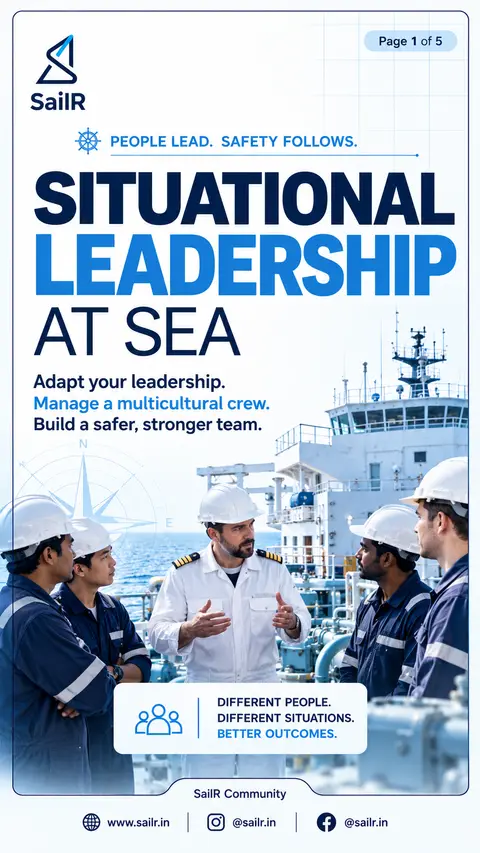
Situational leadership helps shipboard officers adapt their approach to the task and the crew member's readiness. Clear communication, proper familiarisation and effective safety management help a multicultural crew work together safely.
The slides, written out
AI-drawn illustration. Simplified to explain the idea, not to scale.
Slide 1 · Situational leadership at sea means adapting your leadership approach to the task, the…
Situational leadership at sea means adapting your leadership approach to the task, the crew member's competence and willingness, and the circumstances. Effective leadership supports safer operations and stronger shipboard teamwork.
Slide 2 · Situational leadership can be described through four styles
Situational leadership can be described through four styles: directing, coaching, supporting and delegating. Directing provides clear instructions and close follow-up. Coaching explains decisions and develops competence. Supporting encourages participation and shared problem-solving. Delegating gives capable crew members appropriate authority while maintaining oversight. The right approach depends on the task and the person's readiness.
Slide 3 · Leadership under pressure requires officers to assess the situation, consider risks, se…
Leadership under pressure requires officers to assess the situation, consider risks, select an appropriate course of action, communicate clear instructions and evaluate the outcome. Leadership must operate alongside the ship's safety management system and established procedures. Clear orders and verification of compliance support effective safety management.
Slide 4 · Leading a multicultural crew requires clear communication, mutual respect and inclusion
Leading a multicultural crew requires clear communication, mutual respect and inclusion. Officers should use language understood by the crew, use Standard Marine Communication Phrases where appropriate, and request acknowledgement or repeat-back when necessary. Proper familiarisation, training and fair treatment support effective teamwork.
Slide 5 · Building competence, trust and accountability requires officers to identify training ne…
Building competence, trust and accountability requires officers to identify training needs, provide familiarisation and share relevant technical and regulatory information. Tasks should be assigned according to competence and experience, with clear expectations, appropriate authority, supervision and reporting arrangements. Respectful communication and continued learning support safer and more effective shipboard operations.
What it is
Situational leadership means adapting leadership behaviour to the task and the readiness of the person carrying it out. The leader considers the crew member's competence and willingness for that particular task before deciding how much direction, coaching, support or delegated authority is appropriate. These four styles provide a practical framework for thinking about shipboard leadership, rather than a universal rule that prescribes one style for every circumstance. (Situational Leadership model, styles S1–S4)
Directing involves giving clear instructions and maintaining close follow-up. Coaching combines direction with explanation and guidance so that the crew member can develop competence. Supporting involves encouraging participation and helping a capable person work through a problem. Delegating gives a capable and committed person greater responsibility while the officer maintains appropriate oversight. (Situational Leadership model, styles S1–S4)
Why it matters
Marine engineering officers need more than technical knowledge to manage machinery and personnel effectively. The STCW Code identifies leadership and managerial skills as part of the competence required of chief engineer officers and second engineer officers on ships powered by main propulsion machinery of 3,000 kW propulsion power or more. The associated competence includes assessing situations, considering options, selecting a course of action and evaluating results. (STCW Code, Table A-III/2)
The ship's safety management system provides the framework within which leadership decisions are made. The ISM Code establishes the Master's responsibility for implementing the safety and environmental protection policy, motivating the crew to observe that policy, issuing appropriate orders and verifying that specified requirements are observed. It also gives the Master overriding authority and responsibility to make decisions concerning safety and pollution prevention. (ISM Code, paragraphs 5.1.2–5.1.4 and 5.2)
A leadership approach that suits a routine maintenance task may be unsuitable when an immediate safety risk requires decisive action. Conversely, giving every experienced crew member detailed instructions for every routine task can restrict participation and development. The practical requirement is to choose an approach that fits the circumstances while continuing to follow the ship's safety management procedures. (Situational Leadership model, styles S1–S4; ISM Code, paragraph 5.2)
How it works on board
Consider a maintenance task assigned to a recently appointed engineer who has some experience but needs guidance. The senior engineer can explain the task, ask the junior officer to describe the intended procedure and correct misunderstandings before work proceeds. This coaching approach supports learning while allowing the responsible officer to maintain the necessary supervision. Shipboard familiarisation and training are addressed explicitly by the ISM Code. (Situational Leadership model, styles S1–S4; ISM Code, paragraphs 6.3–6.5)
When an experienced engineer is investigating a difficult machinery fault, the senior officer may instead use a supporting approach. The officer can review the available information, invite the engineer's assessment and help evaluate possible actions. The intention is to support the engineer's decision-making without unnecessarily taking over work that the engineer is competent to perform. This is an application of the leadership framework, not a separate regulatory requirement. (Situational Leadership model, styles S1–S4; STCW Code, Table A-III/2)
Delegation requires clear expectations. The officer should identify the task, agree the expected result, provide appropriate authority and resources, and establish suitable reporting and supervision arrangements. Delegation does not remove the responsibilities imposed by the ship's management system or the applicable chain of command. The precise responsibilities depend on the officer's assigned duties and the relevant requirements. (ISM Code, paragraphs 5.1–5.2; STCW Code, Table A-III/2)
Multicultural crew management adds a communication requirement to these decisions. An instruction that appears clear to one officer may be misunderstood by another crew member. The ISM Code addresses familiarisation and requires the company to establish appropriate communication procedures. It also addresses the working language used for safety-related instructions and communication between personnel. Officers should therefore check understanding instead of relying solely on a verbal acknowledgement. (ISM Code, paragraphs 6.3–6.7)
Standard Marine Communication Phrases provide standardised expressions for maritime communication. Where appropriate, officers can use these phrases to reduce ambiguity. A repeat-back or acknowledgement can help establish that an instruction has been received and understood, particularly when the instruction concerns an important operational action. The exact communication procedure should suit the task and the applicable shipboard arrangements. (IMO Resolution A.918(22); ISM Code, paragraphs 6.6–6.7)
Respectful treatment also matters. The Maritime Labour Convention addresses fundamental rights and the employment and social rights of seafarers. Shipboard officers should apply the relevant requirements fairly and maintain a professional working environment in which personnel are treated with respect. (MLC, 2006, Articles III–IV)
The rules
The ISM Code requires the Master to implement the safety and environmental protection policy, motivate the crew, issue appropriate orders and verify compliance with specified requirements. (ISM Code, paragraphs 5.1.2–5.1.4)
The Master retains overriding authority and responsibility for decisions concerning safety and pollution prevention under the safety management system. (ISM Code, paragraph 5.2)
The safety management system must address familiarisation and training for personnel performing duties related to safety and environmental protection. (ISM Code, paragraphs 6.3–6.5)
The company must establish procedures for communication and for personnel to receive relevant information in a working language they understand. (ISM Code, paragraphs 6.6–6.7)
Standard Marine Communication Phrases should be used where applicable to support standardised maritime communication. (IMO Resolution A.918(22))
Officers should maintain competence in applicable ballast-water requirements, including relevant operational requirements under the Ballast Water Management Convention. (BWM Convention, Regulation B-1)
Common mistakes
One mistake is treating a leadership style as a permanent personal preference. Directing every task regardless of the crew member's competence can restrict development, while delegating without suitable oversight can leave expectations unclear. The leadership approach should reflect the task and the person's readiness, with safety requirements remaining in force. (Situational Leadership model, styles S1–S4; ISM Code, paragraphs 5.1–5.2)
Another mistake is assuming that a crew member understands an instruction simply because they acknowledge it. Communication procedures, familiarisation and the use of appropriate standard phrases help officers check whether the intended message has been understood. Officers should correct misunderstandings before they affect the work. (ISM Code, paragraphs 6.3–6.7; IMO Resolution A.918(22))
A further mistake is treating delegation as a transfer of every responsibility. Officers should assign work within the relevant authority and competence arrangements, provide clear expectations and maintain appropriate supervision. They should also ensure that changes in applicable technical or regulatory requirements are communicated to personnel who need that information. (ISM Code, paragraphs 5.1–5.2 and 6.3–6.7)
In exams
Asked 15 times across 7 different questions, most recently in 2026. Asked most in 2nd Mate (6), Chief Mate (5), MEO Class 1 (4).
Sources
- Situational Leadership model, styles S1–S4
- STCW Code, Table A-III/2, leadership and managerial skills
- ISM Code, paragraphs 5.1–5.2, Master's responsibilities and authority
- ISM Code, paragraphs 6.3–6.7, familiarisation, training and communication
- IMO Resolution A.918 22 , Standard Marine Communication Phrases
- IMO Resolution A.954 23 , proper use of VHF channels at sea
- Maritime Labour Convention, 2006, Articles III–IV
- Ballast Water Management Convention, Regulation B-1
Drafted by SailR from the regulations cited. AI-drawn illustration. Simplified to explain the idea, not to scale. Last updated 29 Oct 2026.
Spotted a mistake?