The slides, written out
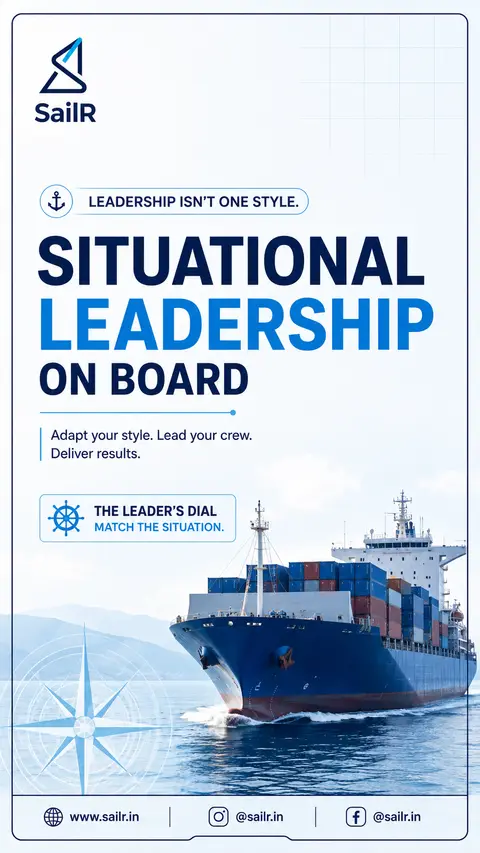
AI-drawn illustration. Simplified to explain the idea, not to scale.
Slide 1 · LEADERSHIP ISN'T ONE STYLE
LEADERSHIP ISN'T ONE STYLE.
SITUATIONAL
LEADERSHIP
ON BOARD
Adapt your style. Lead your crew.
Deliver results.
THE LEADER'S DIAL
MATCH THE SITUATION.
Slide 2 · SLIDE 1 OF 4
LEADERSHIP
IS SITUATIONAL
Leadership is not a fixed switch.
It is a dial.
The right leadership behaviour depends on:
TASK
What needs to be done?
URGENCY
How quickly must we act?
LEADERSHIP DIAL
CREW
What is their experience and capability?
RISK
What is the consequence of failure?
EXAM ANCHOR
THERE IS NO ONE BEST LEADERSHIP STYLE.
Effective leadership matches the leader, followers, task and environment.
Slide 3 · SLIDE 2 OF 4
THREE LEADERSHIP
THEORY LENSES
Leadership theory helps explain how effective leadership
can depend on the leader, the followers, the task and the situation.
01
TRAIT THEORY
Focuses on characteristics associated
with effective leadership.
Calmness
Honesty
Decisiveness
Confidence
Integrity
02
SITUATIONAL / BEHAVIOURAL APPROACH
Leadership behaviour can be adapted
according to the circumstances.
Directive when immediate coordinated
action is required.
Participative when crew knowledge and
experience can improve the decision.
Delegative when competent personnel can take
responsibility within defined limits.
03
CONTINGENCY APPROACH
Leadership effectiveness depends on the fit
between the leader, followers, task and environment.
LEADER
FOLLOWERS
TASK
ENVIRONMENT
KEY POINT
Effective leadership depends on choosing
behaviour that fits the situation.
EXAM REFERENCE
STCW Code – Management Level:
Use of Leadership and Managerial Skills
Slide 4 · SLIDE 3 OF 4
THE LEADERSHIP DIAL
IN ACTION
Choose the leadership style that fits the situation.
COMMAND
EMERGENCY / IMMEDIATE RISK
Collision • Grounding • Fire • Serious flooding
Give clear, calm and decisive orders.
No unnecessary debate.
Immediate coordinated action is required.
PARTICIPATIVE
PLANNING / ROUTINE OPERATIONS
Cargo operations • Mooring plans • Drills
Use the knowledge and experience of the crew.
Encourages involvement.
Builds ownership and better outcomes.
DELEGATIVE
EXPERIENCED / TRUSTED TEAM
Routine watchkeeping • Established operations
Set clear expectations.
Delegate authority.
Allow competent personnel to take responsibility.
REMEMBER
Good leadership is not about always being strict or always being democratic. It is about choosing what the situation requires.
Slide 5 · SLIDE 4 OF 4
WHAT REAL
AUTHORITY LOOKS LIKE
RANK GIVES POSITION.
LEADERSHIP EARNS TRUST.
A COMPETENT OFFICER:
KNOWS THE JOB
Sound knowledge builds confidence and respect.
SEEK ADVICE
Ask for advice when needed. Good leaders listen.
CALM & EVEN TEMPERED
Stay calm and in control, especially under pressure.
DELEGATE APPROPRIATELY
Delegate tasks and trust competent personnel.
HONEST & FAIR
Be honest, fair and firm when necessary.
APPRECIATE CONTRIBUTIONS
Recognise good work. Appreciation builds loyalty.
TREAT ALL FAIRLY
No favourites. Respect every person equally.
CULTURAL & LANGUAGE AWARENESS
Communicate clearly across language and cultural differences. Verify understanding.
GIVE CLEAR INSTRUCTIONS
Give clear orders and ensure they are understood.
ACCEPT & FOLLOW ORDERS
Accept and carry out legitimate orders from your superiors.
FINAL EXAM LINE
ASSESS THE SITUATION
CHOOSE THE APPROPRIATE LEADERSHIP BEHAVIOUR
COMMUNICATE CLEARLY
VERIFY UNDERSTANDING
MAINTAIN CONTROL
REFERENCE
STCW Code – Management level leadership competence (Table A-II/2 & A-III/2)
DG Shipping – Chief Mate Phase I Syllabus, Competence No. 19: Use of leadership and managerial skills
IMO Model Course 1.40 – Use of Leadership and Managerial Skills
ISM Code – Safe management and effective communication
IMO Standard Marine Communication Phrases (SMCP) – Resolution A.918(22)
Drafted by SailR from our daily lessons. AI-drawn illustration. Simplified to explain the idea, not to scale. Last updated 19 Oct 2026.
Spotted a mistake?