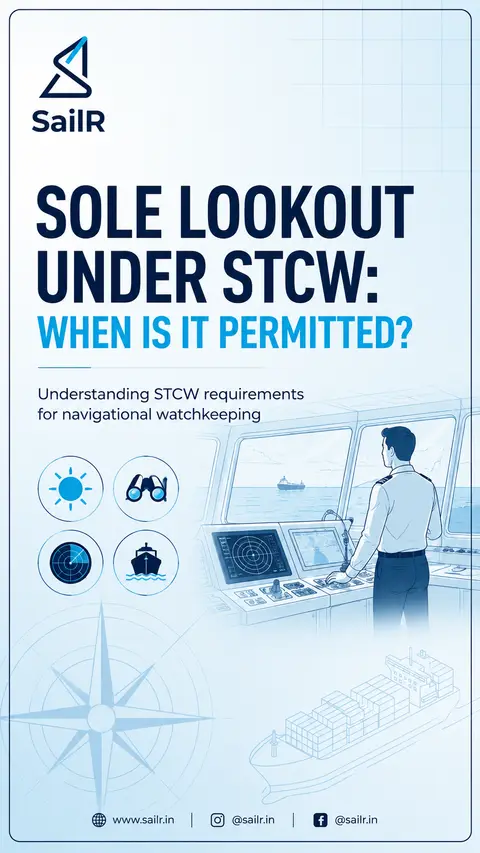
The slides, written out
AI-drawn illustration. Simplified to explain the idea, not to scale.
Slide 1 · SOLE LOOKOUT
SOLE LOOKOUT
UNDER STCW:
WHEN IS IT PERMITTED?
Understanding STCW requirements
for navigational watchkeeping
Slide 2 · 02 / 04
WHEN CAN THE OOW
BE THE SOLE LOOKOUT?
STCW permits the Officer of the Watch (OOW)
to act as the sole lookout only during
daylight hours and only after careful
assessment confirms it is safe to do so.
ALL OF THE FOLLOWING MUST BE CONSIDERED:
Weather conditions
Visibility
Traffic density
Proximity of navigational hazards
Operations in or near
Traffic Separation Schemes (TSS)
Availability of immediate assistance
DAYLIGHT HOURS ONLY
Sole-lookout arrangements
are not permitted during
the hours of darkness.
KEY MESSAGE
The sole-lookout arrangement is
the exception, not the normal practice.
REFERENCE
STCW Code Section A-VIII/2
| |
Slide 3 · 03 / 04
WHEN SHOULD
ASSISTANCE BE CALLED?
Call for additional lookout support when your
ability to maintain a continuous state of
vigilance is compromised.
CALL FOR ADDITIONAL LOOKOUT SUPPORT WHEN:
Deteriorating Visibility
Fog, heavy rain, snow, or any reduction in visibility.
Increased Traffic Density
When traffic increases and workload rises.
Navigating in or Near a TSS
High concentration of traffic and route-keeping demands.
Proximity of Dangers to Navigation
Channels, landfall, shoals, or other navigational hazards.
Equipment Failure or Technical Issues
Radar faults, steering issues, or any system failure.
Increased Workload or Personal Factors
Tiredness, distraction, heavy administrative tasks.
Your Professional Judgment
If you feel the situation is becoming busy or unsafe.
WHEN IN DOUBT,
CALL FOR HELP.
Safe navigation
depends on early action
and effective teamwork.
KEY MESSAGE
If continuous vigilance cannot be maintained
effectively, additional assistance should be
summoned immediately.
REFERENCE
COLREG Rule 5
STCW Code Section A-VIII/2
Slide 4 · 04 / 04
HOW IS “IMMEDIATELY AVAILABLE” ACHIEVED?
A pre-agreed system and effective communication ensure prompt assistance whenever required.
01
IDENTIFY THE STANDBY CREW MEMBER
Designate a specific person who can act as immediate relief and is not engaged in critical tasks.
02
CONFIRM COMMUNICATION
Ensure bridge call, internal phone or radio communication is tested and in working order.
03
ENSURE PROMPT AVAILABILITY
The standby person must be nearby and able to reach the bridge without delay when called.
04
FOLLOW STANDING ORDERS
Comply with the Master's standing orders and the company's SMS procedures.
05
CALL BEFORE IT BECOMES CRITICAL
Request assistance early—before the situation becomes complex or risky.
KEY MESSAGE
SAFE WATCHKEEPING RELIES ON PREPARATION, COMMUNICATION AND EARLY INTERVENTION.
REFERENCE
STCW Code Section A-VIII/2
Drafted by SailR from our daily lessons. AI-drawn illustration. Simplified to explain the idea, not to scale. Last updated 19 Oct 2026.
Spotted a mistake?