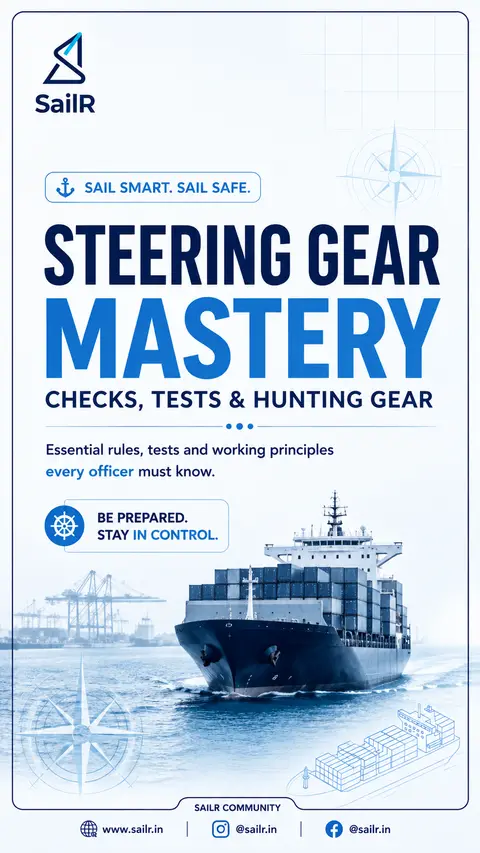
The slides, written out
AI-drawn illustration. Simplified to explain the idea, not to scale.
Slide 1 · SAIL SMART
STEERING GEAR
MASTERY
CHECKS, TESTS & HUNTING GEAR
Essential rules, tests and working principles
every officer must know.
BE PREPARED.
STAY IN CONTROL.
Slide 2 · SOLAS CHAPTER V, REGULATION 26
SOLAS CHAPTER V, REGULATION 26
STEERING GEAR:
THE 12 HOUR RULE
Before departure, the ship's steering gear must be checked and tested by the crew within 12 hours before departure.
For ships regularly engaged on short duration voyages, the Administration may waive this interval, provided the checks and tests are carried out at least once every week.
9 KEY ITEMS TO TEST
01 Main steering gear
02 Auxiliary steering gear
03 Remote steering gear control systems
04 Steering positions on the navigation bridge
05 Emergency power supply
06 Rudder angle indicators vs actual rudder position
07 Remote control system power failure alarms
08 Steering gear power unit failure alarms
09 Automatic isolating arrangements and other automatic equipment
These items are tested where applicable to the ship's arrangement.
| |
Slide 3 · SolAS CHAPTER V, REGULATION 26
SolAS CHAPTER V, REGULATION 26
WHAT ELSE
MUST BE CHECKED?
SOLAS V/26 requires the checks and tests to include:
FULL RUDDER MOVEMENT
Operate the rudder through its required range according to the steering gear's capabilities.
VISUAL INSPECTION
Inspect the steering gear and its connecting linkage. Look for abnormal conditions, damage, leakage or defects.
COMMUNICATION TEST
Test communication between the navigation bridge and the steering gear compartment.
STEERING PERFORMANCE
MAIN STEERING GEAR
35°
30°
≤ 28 SECONDS
From 35° on either side to 30° on the other side in not more than 28 seconds.
Condition: Ship at its deepest seagoing draught and proceeding ahead at maximum ahead service speed.
AUXILIARY STEERING GEAR
15°
15°
≤ 60 SECONDS
From 15° on either side to 15° on the other side in not more than 60 seconds.
Condition: Ship at its deepest seagoing draught and proceeding ahead at ½ maximum ahead service speed or 7 knots, whichever is greater.
These performance requirements come from SOLAS II-1/29, while the pre-departure testing requirement is in SOLAS V/26.
Slide 4 · SOLAS CHAPTER V, REGULATION 26
SOLAS CHAPTER V, REGULATION 26
EMERGENCY STEERING
& RECORDS
The test is not complete until the crew can respond
to failure and the records are properly maintained.
EMERGENCY STEERING DRILL
Required
at least once
every 3 months.
The drill must include:
01
DIRECT CONTROL
Operate steering directly
from the steering gear
compartment.
02
COMMUNICATION
Practise the communication
procedure between the steering
gear compartment and the
navigation bridge.
03
ALTERNATIVE POWER
Operate alternative power
supplies, where applicable.
DON'T FORGET THE RECORD
LOG
SOLAS requires the date of the steering gear
checks/tests and the date and details of
emergency steering drills to be recorded.
The exact format of the record is to be
in accordance with the Administration
and the ship's SMS procedures.
INSTRUCTIONS MUST BE VISIBLE
STEERING GEAR
OPERATING INSTRUCTIONS
Simple operating instructions with a block diagram
showing the changeover procedures for:
Remote steering gear control systems
Steering gear power units
These instructions must be permanently displayed
on the navigation bridge and in the steering
gear compartment.
Slide 5 · ENGINEERING BEHIND ACCURATE CONTROL
ENGINEERING BEHIND ACCURATE CONTROL
HUNTING GEAR
THE FEEDBACK THAT RETURNS
THE CONTROL TO NEUTRAL
In a follow-up electro-hydraulic steering system, the hunting gear feeds back the actual rudder position to the control system.
WHAT IS HUNTING GEAR?
A feedback mechanism that compares the helm order (demand) with the actual rudder position and returns the control towards neutral when the ordered angle is reached.
TYPICAL COMPONENTS*
Feedback linkage / rod from the steering gear (tiller arm, ram or rotor)
Levers and linkages that transmit movement back to the control valve or telemotor receiver
Floating lever arrangement that compares demand with feedback
* Configuration may vary with steering gear design and manufacturer.
HOW IT WORKS
1 HELM ORDER - Helmsman turns the wheel.
2 CONTROL VALVE SHIFT - Pilot valve opens. Oil flows to the steering gear.
3 RUDDER MOVES - Rudder starts to move.
4 FEEDBACK FROM RUDDER POSITION - Hunting gear feeds movement back to the control.
5 CONTROL RETURNS TOWARDS NEUTRAL - When feedback equals demand, control moves towards neutral.
6 RUDDER HOLDS ORDERED ANGLE - Oil flow stops. Rudder holds the ordered angle.
WHY IT MATTERS
Provides feedback so the steering gear can maintain the ordered rudder position.
Allows accurate positioning of the rudder to match the helm order.
Gives the helmsman a natural feel – the wheel corresponds to a rudder angle, not just a direction of motion.
Note: Hunting gear arrangements and control architectures vary. Not all modern steering systems use a traditional mechanical hunting gear.
IF THE HUNTING GEAR FAILS
The exact effect depends on the steering gear design and the nature/direction of the failure. Possible consequences include:
Loss of accurate follow-up control.
Abnormal rudder positioning or continued rudder movement.
Difficulty in maintaining the ordered rudder angle, especially in confined waters.
Potential for high pressure or overheating if the system continues to drive against limit or is misoperating.
Drafted by SailR from our daily lessons. AI-drawn illustration. Simplified to explain the idea, not to scale. Last updated 19 Oct 2026.
Spotted a mistake?