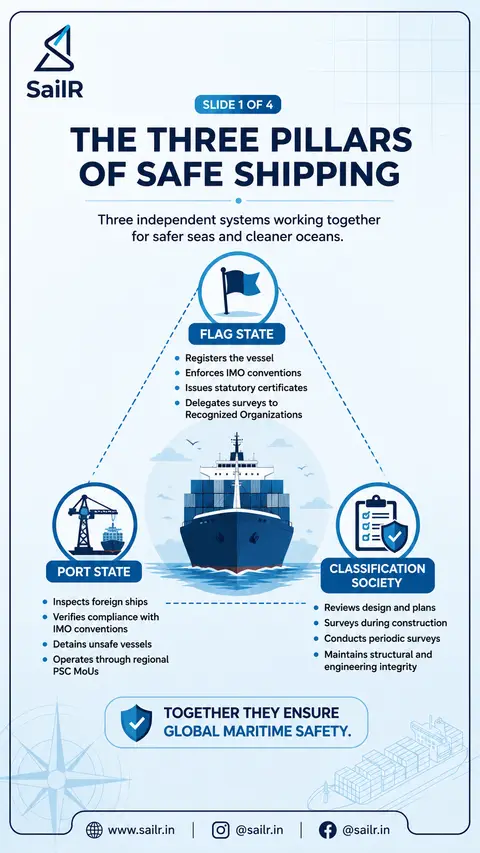
AI-drawn illustration. Simplified to explain the idea, not to scale.
Slide 1 · SLIDE 1 OF 4
THE THREE PILLARS
OF SAFE SHIPPING
Three independent systems working together
for safer seas and cleaner oceans.
FLAG STATE
Registers the vessel
Enforces IMO conventions
Issues statutory certificates
Delegates surveys to
Recognized Organizations
PORT STATE
Inspects foreign ships
Verifies compliance with
IMO conventions
Detains unsafe vessels
Operates through regional
PSC MoUs
CLASSIFICATION
SOCIETY
Reviews design and plans
Surveys during construction
Conducts periodic surveys
Maintains structural and
engineering integrity
TOGETHER THEY ENSURE
GLOBAL MARITIME SAFETY.
Slide 2 · SLIDE 2 OF 4
WHO DOES WHAT?
Understanding the roles and responsibilities
in the maritime safety framework.
FLAG STATE
Registers ships and exercises jurisdiction
Issues statutory certificates
Enforces compliance with IMO conventions
Authorizes Recognized Organizations (ROs) to carry out surveys
Conducts initial, periodic and renewal surveys
PORT STATE
Inspects foreign ships in port
Verifies compliance with IMO conventions
Detains ships with serious deficiencies
Operates through regional PSC MoUs
Uses risk profile to determine inspection frequency
CLASSIFICATION SOCIETY
Reviews design and verifies calculations
Surveys during construction
Conducts periodic surveys in service
Issues Conditions of Class for defects
Ensures structural and engineering integrity of the vessel
THE SAFETY CHAIN
DESIGN
CONSTRUCTION
CERTIFICATION
OPERATION
PORT INSPECTION
CONTINUOUS COMPLIANCE & SAFETY
These three pillars work together to prevent accidents, protect the marine environment and safeguard human life.
Slide 3 · SLIDE 3 OF 4
DRY DOCK
SURVEY CHECKLIST
Key areas the Class Surveyor will examine
during the docking survey.
ITEM / AREA
WHAT TO CHECK
REFERENCE / NOTES
HULL – EXTERNAL
Plating condition, corrosion, deformation,
weld integrity, thickness (UT), anodes,
sea chest gratings, rudder, rope guard.
Class Rules &
ESP (if applicable)
PROPELLER
& SHAFT
Propeller blades, cracks, dents,
cavitation, key/keyway, shaft cone
nut, rope guard, tail shaft bearing
wear-down (reading).
Class Rules
(shaft survey
requirements)
SEA CHESTS
/ VALVES
Clean and clear gratings, overboard
valves operation, seat tightness,
anodes, ICCP (if fitted) readings.
Class Rules;
SOLAS (fire-main
isolation valves)
RUDDER
Rudder stock clearance (top & bottom),
coupling bolts, rudder trunk watertight
integrity, steering gear earth bond.
Class Rules;
SOLAS II-1
(steering gear)
STERN TUBE
/ SEALS
Check for oil leakage, seal condition,
seal oil consumption history, bulbous
bow & transom frame.
Maker's Manual;
Previous Survey
Report
ANODES
Type and condition, residual thickness,
spacing & attachment, bonded anodes
for tank protection.
Class Rules &
Cathodic Protection
Specifications
STRUCTURAL ITEMS
(ESP)
Close-up survey of bottom shell, bilge
keel, chock area and other areas as
per ESP requirements.
SOLAS XI-1;
IACS UR Z11 /
ESP Requirements
CLASS
REQUIREMENTS
Ensure all previous Conditions of Class
are rectified. Arrange Class Surveyor
attendance. Have docking plan ready.
Survey Program
Document
THICKNESS
MEASUREMENT
Confirm approved UT gauging plan.
Areas: bottom shell, side shell, deck
strakes in way of holds/tanks.
ESP / Class
Requirements
GENERAL
PREPAREDNESS
Drydock blocks, staging & access,
permits, lighting, gas freeing for
tank/compartment entry.
Company SMS;
SOLAS II-2 Reg.15
(gas testing)
USE NOTES
Review previous survey report and note any pending recommendations.
Walk the hull with the surveyor – mark defects on plan and take photos.
Agree on temporary/permanent repair with yard and surveyor.
Obtain docking survey report and renewed Certificate of Class.
Regular docking surveys ensure structural integrity,
safety of life at sea and protection of the environment.
Slide 4 · SLIDE 4 OF 4
CLASS SURVEY CYCLE
& CONTINUOUS COMPLIANCE
Regular surveys. Verified compliance. Safer voyages.
5-YEAR CLASS SURVEY CYCLE
THE CONTINUOUS SAFETY PROCESS
COMMISSIONING
Vessel enters class.
Initial surveys completed.
YEAR 1
ANNUAL SURVEY
Annual survey of hull,
machinery and systems.
YEAR 2
ANNUAL +
INTERMEDIATE*
Annual survey plus
intermediate survey
(timing per class rules).
YEAR 3
ANNUAL SURVEY
Annual survey of hull,
machinery and systems.
YEAR 4
ANNUAL SURVEY
Annual survey of hull,
machinery and systems.
YEAR 5
SPECIAL SURVEY
+ BOTTOM SURVEY
Comprehensive survey,
bottom survey (drydock
or in-water).
CERTIFICATE
RENEWAL
Class certificate
renewed for next
5-year cycle.
* Timing of intermediate survey may be
in Year 2 or Year 3 depending on the
classification society.
DESIGN & APPROVAL
Plans reviewed and approved
in accordance with Class Rules
and statutory requirements.
CONSTRUCTION
Surveys during construction
ensure build quality and
compliance.
CLASSIFICATION
Vessel assigned class and
enters survey program.
FLAG CERTIFICATION
Flag State issues statutory
certificates based on surveys
and compliance.
SHIP IN SERVICE
Vessel operates safely in
compliance with conventions
and company SMS.
PORT STATE CONTROL
Foreign ports inspect the ship
to verify compliance and may
detain for serious deficiencies.
CONTINUOUS COMPLIANCE
Ongoing surveys, maintenance
and inspections ensure a safe,
compliant and reliable vessel.
SAFE SHIPS. CLEANER OCEANS. STRONGER FUTURE.
The three pillars – Flag State, Port State and Classification Society –
work together through a continuous cycle of surveys and inspections
to protect life, property and the marine environment.
| |