The slides, written out
AI-drawn illustration. Simplified to explain the idea, not to scale.
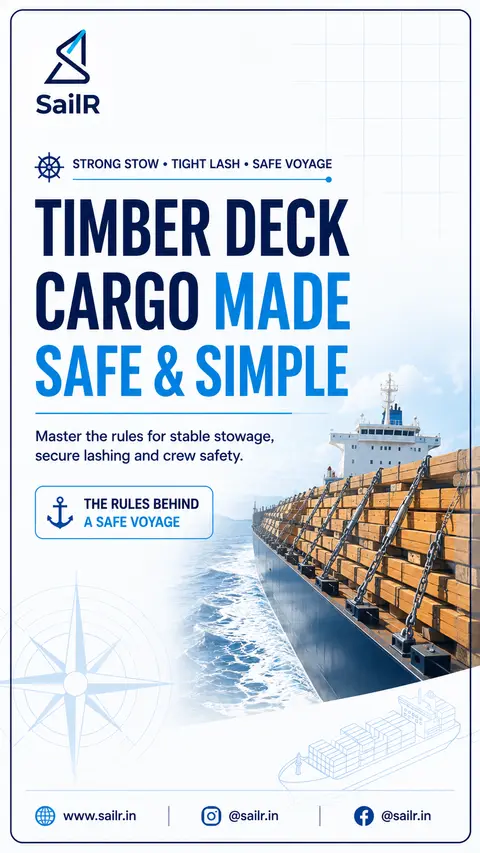
Slide 1 · STRONG STOW • TIGHT LASH • SAFE VOYAGE
STRONG STOW • TIGHT LASH • SAFE VOYAGE
TIMBER DECK
CARGO MADE
SAFE & SIMPLE
Master the rules for stable stowage,
secure lashing and crew safety.
THE RULES BEHIND
A SAFE VOYAGE
Slide 2 · SLIDE 1 OF 4
TIMBER DECK CARGO:
STABILITY FIRST
Timber deck cargo can provide additional buoyancy,
but the applicable Load Line and stability requirements
must be satisfied.
2008 IS CODE
For ships carrying timber deck cargo, the normal intact stability
criteria in IS Code 2.2 and 2.3 apply unless the Administration
accepts the alternative timber criteria in 3.3.2.
NORMAL CRITERIA – IS CODE 2.2
GZ AREA
• 0°–30° ≥ 0.055 m·rad
• 0°–40° or flooding angle ≥ 0.09 m·rad
• 30°–40° or flooding angle ≥ 0.03 m·rad
GZ ≥ 0.20 m
at 30° or greater
MAXIMUM GZ:
≥ 25°
GM₀:
≥ 0.15 m
TIMBER ALTERNATIVE – IS CODE 3.3.2
GZ AREA:
≥ 0.08 m·rad
up to 40° or
flooding angle
MAXIMUM GZ:
≥ 0.25 m
GM:
≥ 0.10 m
throughout
the voyage
BOTTOM TAKEAWAY
Timber cargo does not replace stability assessment –
it changes the applicable stability provisions
when the required conditions are met.
Slide 3 · SLIDE 2 OF 4
TIMBER DECK CARGO:
STOW IT RIGHT
A solid, compact and stable stow prevents movement that could cause the securing arrangements to slacken or the cargo to shift.
LONGITUDINAL EXTENT
The timber deck cargo should extend longitudinally between superstructures.
If there is no limiting superstructure at the after end, extend at least to the after end of the aftermost hatchway.
TRANSVERSE EXTENT
The cargo should extend across the full beam, allowing for a rounded gunwale.
Maximum allowance for rounded gunwale:
4% OF SHIP'S BREADTH
UPRIGHTS (IF REQUIRED)
• Use adequately designed uprights.
• Uprights should be suitable for the breadth of the ship.
• Spacing not more than 3 m.
• Secured in strong angles, metal sockets or equally efficient means.
SHORT TIMBER PACKAGES
For outboard packages less than 3.6 m long:
Reduce lashing spacing as necessary or provide other suitable securing arrangements.
< 3.6 m
BOTTOM TAKEAWAY
A compact and well-distributed stow is the first line of defence against cargo movement.
Slide 4 · SLIDE 3 OF 4
TIMBER DECK CARGO:
LASHING • KNOW THE NUMBERS
The ship's Cargo Securing Manual and approved securing arrangement remain central to the operation.
The 2011 Timber Deck Cargo Code provides the design principles.
LASHING SPACING
PACKAGED SAWN WOOD
STOWAGE HEIGHT | MAXIMUM SPACING
≤ 2.5 m | 3 m
> 2.5 m | 1.5 m
For the foremost and aft-most sections, the applicable spacing should be HALVED.
For ROUND WOOD: 1.5 m spacing irrespective of height.
For outboard packages < 3.6 m: Reduce spacing as necessary or use other suitable provisions.
Turnbuckle
Chain length for adjustment
Sliphook
Lashings must be accessible so that they can be adjusted during the voyage.
LASHING STRENGTH
MINIMUM BREAKING STRENGTH
133 kN
Lashings and components ≤ 5% elongation at 80% MBL
No permanent deformation after proof load ≥ 40% of original breaking strength
TIGHTENING DEVICE (MINIMUM LOAD)
HORIZONTAL
27 kN
VERTICAL
16 kN
BOTTOM TAKEAWAY
Do not substitute old generic lashing figures. Follow the 2011 Timber Deck Cargo Code and your ship's approved Cargo Securing Manual.
| SailR Community | |
Slide 5 · SLIDE 4 OF 4
TIMBER DECK CARGO:
SAFETY ALL THE WAY
THE JOB DOESN'T END AT DEPARTURE
Timber cargo can settle, absorb water and alter the ship's condition.
Stability and securing arrangements must be maintained
throughout the voyage.
STABILITY THROUGHOUT THE VOYAGE
Water absorption
by timber
Ice accretion
where applicable
Fuel and stores
consumption
Free surface
effects
For the timber
alternative criteria
(IS Code 3.3.2):
GM ≥ 0.10 m
throughout the voyage,
taking account of water
absorption and ice
accretion.
CREW ACCESS & PROTECTION
Centreline
lifeline
Guard rails /
lifelines
≤ 330 mm
vertical
spacing
≥ 1 m
above
cargo
Walking surface ≥ 600 mm wide
(where cargo is uneven)
Guard rails or lifelines with
≤ 330 mm vertical spacing.
Height of railing/lifeline
at least 1 m above cargo.
Centreline lifeline, preferably
wire rope and kept taut.
Safe walking surface
≥ 600 mm wide where
cargo is uneven.
ACCESS MUST REMAIN SAFE
Cargo arrangements
must not obstruct safe
access to:
Machinery
spaces
Sounding
pipes
Safety
equipment
Fire-fighting
equipment
Escape
routes
Obstructions must not prevent safe access or egress at all times.
FINAL TAKEAWAY
STABILITY → STOWAGE → SECURING →
CREW ACCESS → VOYAGE MONITORING
A timber deck cargo is only as safe as its stow,
securing system and continuing voyage checks.
Drafted by SailR from our daily lessons. AI-drawn illustration. Simplified to explain the idea, not to scale. Last updated 19 Oct 2026.
Spotted a mistake?