Total Quality Management (TQM) in the Maritime Industry: Principles and Shipboard Applications
Total Quality Management is an approach to improving processes, meeting requirements and building a culture of continuous improvement. Learn how its principles connect with the ISM Code, ship maintenance, reporting, audits and engineering problem-solving.
The slides, written out
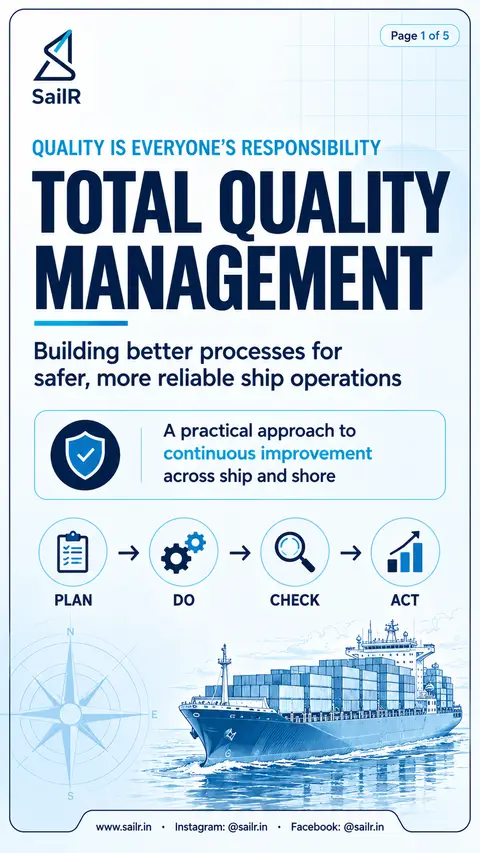
AI-drawn illustration. Simplified to explain the idea, not to scale.
Slide 1 · Total Quality Management is an organisation-wide approach to improving quality through…
Total Quality Management is an organisation-wide approach to improving quality through leadership, process management, evidence-based decisions and continuous improvement. In maritime operations, these principles can support safer and more reliable shipboard and shore-based work.
Slide 2 · The seven quality management principles are customer focus, leadership, engagement of p…
The seven quality management principles are customer focus, leadership, engagement of people, process approach, improvement, evidence-based decision-making and relationship management. Together, they help organisations manage connected processes, meet requirements and improve performance.
Slide 3 · The Plan-Do-Check-Act cycle provides a structured method for improvement
The Plan-Do-Check-Act cycle provides a structured method for improvement. Plan objectives and resources, implement the planned action, check measured results against requirements and act to improve performance.
Slide 4 · The ISM Code requires a Safety Management System with procedures for reporting and anal…
The ISM Code requires a Safety Management System with procedures for reporting and analysing non-conformities, accidents and hazardous situations. It also addresses ship and equipment maintenance, corrective action, internal verification and management review. These requirements overlap with quality management practices, but the ISM Code does not mandate TQM as a named philosophy.
Slide 5 · Quality control focuses on operational checking, while quality assurance uses planned a…
Quality control focuses on operational checking, while quality assurance uses planned arrangements to provide confidence that requirements will be met. Maintenance planning, project scheduling, failure mode and effects analysis, fault-tree analysis, root-cause analysis and cause-and-effect diagrams can support engineering decisions and improvement when appropriately applied.
What it is
Total Quality Management (TQM) is an organisation-wide approach to managing quality and improving the way work is performed. It involves leadership, employee engagement, process management, evidence-based decisions and a continuing effort to meet requirements. Quality is considered across connected activities rather than treated only as a final inspection task. The aim is to improve the consistency and effectiveness of the organisation's processes. (ISO 9001:2015, Introduction 0.2–0.3.1)
The seven quality management principles are customer focus, leadership, engagement of people, process approach, improvement, evidence-based decision-making and relationship management. These principles provide a framework for understanding how an organisation can manage requirements and improve its performance. Their application depends on the organisation and the work being performed. (ISO 9001:2015, Introduction 0.2)
Why it matters
A ship depends on many connected activities. Maintenance, inspections, operational procedures, reporting and management decisions all affect how work is carried out. A process approach considers these activities as an interacting system. It helps the organisation understand how one activity affects another and where monitoring or improvement may be needed. (ISO 9001:2015, Introduction 0.3.1)
The Plan-Do-Check-Act cycle gives the organisation a structured way to improve its processes. Plan the objectives, resources and actions. Do the planned work. Check the results against the intended requirements. Act on what the evaluation shows. The cycle can be applied to individual processes or to a management system as a whole. (ISO 9001:2015, Introduction 0.3.2)
How it works on board
The ISM Code provides an important maritime application of disciplined management. It requires companies to establish a Safety Management System that supports safe ship operation and pollution prevention. The Code includes requirements for defined responsibilities, shipboard procedures and safeguards against identified risks. These requirements overlap with quality management practices, but the ISM Code does not prescribe TQM as a named management philosophy. (ISM Code, Sections 1.2 and 1.4)
Reporting must lead to useful investigation. Under Section 9, the SMS should include procedures to report non-conformities, accidents and hazardous situations to the company. Those events should be investigated and analysed with the objective of improving safety and pollution prevention. The company should also establish procedures for corrective action. The practical value lies in identifying what happened, analysing the available evidence and addressing the causes that can be supported by the investigation. (ISM Code, Sections 9.1–9.2)
Maintenance is another direct application. The company should establish procedures to maintain the ship and its equipment in conformity with relevant rules and regulations and additional company requirements. The Code addresses inspections at appropriate intervals, reporting non-conformities, corrective action and records. It also requires attention to equipment whose sudden operational failure could create a hazardous situation, with measures to promote reliability. (ISM Code, Sections 10.1–10.4)
The rules
The ISM Code requires a Safety Management System to support safe ship operation and pollution prevention. (ISM Code, Sections 1.2 and 1.4)
The SMS should contain procedures for reporting, investigating and analysing non-conformities, accidents and hazardous situations. (ISM Code, Section 9.1)
The company should establish corrective-action procedures. (ISM Code, Section 9.2)
The company should establish ship and equipment maintenance procedures, including inspections, reporting, corrective action and records. (ISM Code, Sections 10.1–10.4)
The company should verify and evaluate the SMS, carry out internal safety audits and periodically review its effectiveness. (ISM Code, Sections 12.1–12.7)
These provisions establish specific SMS obligations. They should not be described as a statutory requirement to adopt TQM itself. The quality management principles can help explain the value of disciplined processes and improvement, but the applicable Code provisions determine the maritime requirements. (ISM Code, Sections 1, 9, 10 and 12)
Common mistakes
One mistake is to confuse quality control with quality assurance. Quality control focuses on checking and controlling outputs, while quality assurance concerns the planned arrangements used to provide confidence that requirements will be met. Both can contribute to a quality management system, and their practical activities can overlap. They should not be reduced to an absolute distinction between inspection and prevention. (ISO 9000 family, quality management vocabulary and principles)
Another mistake is to investigate a failure without checking whether corrective action has worked. Reporting and investigation should lead into the procedures established for corrective action. A useful improvement process checks the results against the intended objective and acts on the evidence. The PDCA cycle provides a framework for organising that work. (ISM Code, Section 9.2; ISO 9001:2015, Introduction 0.3.2)
Engineering tools also need to be selected for the problem. FMEA examines potential failure modes and their effects. Fault-tree analysis examines combinations of events that can lead to a defined top event. Root-cause analysis and cause-and-effect diagrams help structure an investigation. These are analytical tools, not substitutes for reliable evidence, competent judgement or the company's applicable procedures.
Maintenance planning and project scheduling can help organise complex work, including dry-docking. Their usefulness depends on the job, the available information and the constraints that must be managed. No single scheduling or failure-analysis method is suitable for every situation.
Sources
- ISO 9001:2015, Introduction 0.2, Quality management principles; Introduction 0.3.1, Process approach; Introduction 0.3.2, Plan-Do-Check-Act cycle.
- IMO, Resolution A.741 18 , International Management Code for the Safe Operation of Ships and for Pollution Prevention ISM Code , Sections 1.2 and 1.4, safety management objectives and the SMS.
- IMO, Resolution A.741 18 , ISM Code, Sections 9.1–9.2, reporting, analysis and corrective action.
- IMO, Resolution A.741 18 , ISM Code, Sections 10.1–10.4, maintenance of the ship and equipment.
- IMO, Resolution A.741 18 , ISM Code, Sections 12.1–12.7, company verification, evaluation and review.
- ISO, The process approach in ISO 9001:2015.
Drafted by SailR from the regulations cited. AI-drawn illustration. Simplified to explain the idea, not to scale. Last updated 23 Oct 2026.
Spotted a mistake?