The slides, written out
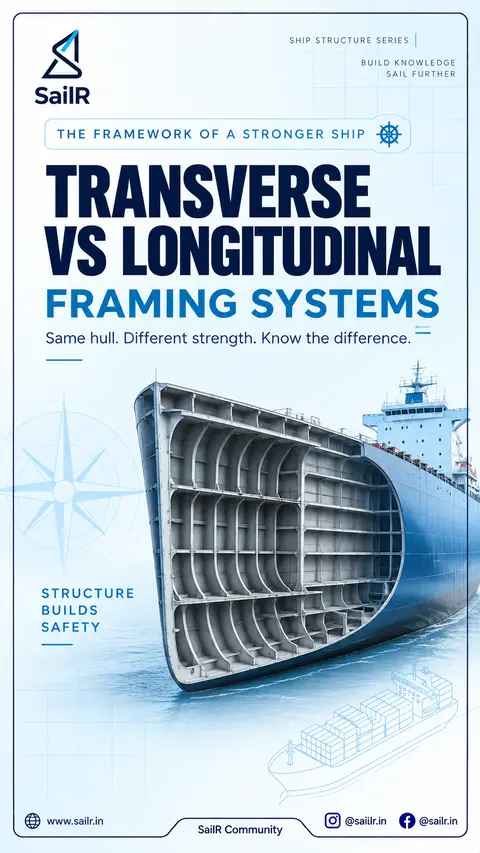
AI-drawn illustration. Simplified to explain the idea, not to scale.
Slide 1 · SHIP STRUCTURE SERIES
SHIP STRUCTURE SERIES
BUILD KNOWLEDGE
SAIL FURTHER
THE FRAMEWORK OF A STRONGER SHIP
TRANSVERSE
VS LONGITUDINAL
FRAMING SYSTEMS
Same hull. Different strength. Know the difference.
STRUCTURE
BUILDS
SAFETY
Slide 2 · SHIP STRUCTURE SERIES
SHIP STRUCTURE SERIES
BUILD KNOWLEDGE
SAIL FURTHER
TRANSVERSE FRAMING
THE TRADITIONAL RIBCAGE
Frames run across the ship, providing strong transverse support to the hull structure.
WHAT IT IS
Frames run athwartships (across the ship) and are relatively closely spaced. The exact spacing depends on ship type, structural location, loading and classification requirements.
HOW IT WORKS
The transverse frames stiffen the shell and deck structure and provide support against transverse and local loads.
WHERE YOU'LL FIND IT
Common in many ships and in structural regions where transverse framing is appropriate. It is also used in complex end regions (such as the bow and stern) where hull geometry and local structural requirements govern the arrangement.
KEY FEATURES
Provides good resistance to transverse and local loads.
Contributes to overall hull girder strength
Widely used in many ship types and structural regions
Transverse frames (athwartships)
Deck connection
Frame
View of hull section with transverse framing (typical arrangement)
EXAM TIP
Transverse framing provides transverse and local support, while longitudinal framing is generally more efficient for resisting longitudinal bending.
Slide 3 · SHIP STRUCTURE SERIES
SHIP STRUCTURE SERIES
BUILD KNOWLEDGE
SAIL FURTHER
LONGITUDINAL FRAMING
THE MODERN SPINE
A highly efficient framing system that gives excellent resistance to longitudinal bending.
WHAT IT IS
Frames run fore and aft (along the ship's length). The bottom, side and deck are stiffened by a large number of closely spaced longitudinal members.
HOW IT WORKS
The longitudinal members make the hull act like a box girder, giving excellent resistance to hogging and sagging — the biggest stresses a ship faces at sea.
WHERE YOU'LL FIND IT
Widely used in large ships such as oil tankers, bulk carriers and container ships, where long, unbroken lengths of hull must resist longitudinal bending. The exact arrangement depends on ship type and design.
KEY FEATURES
Stronger for its weight
More cargo capacity per tonne of steel
Closely spaced longitudinals divide the plating into panels
Transverse web frames support the longitudinals
Longitudinal members (fore and aft)
Transverse web frame (supports longitudinals)
View of hull section with longitudinal framing
EXAM TIP
Longitudinal framing is generally more efficient for longitudinal hull girder strength, especially in large ships.
Slide 4 · SHIP STRUCTURE SERIES
SHIP STRUCTURE SERIES
BUILD KNOWLEDGE
SAIL FURTHER
THE HYBRID TRUTH
MANY SHIPS USE BOTH
A ship does not use only one framing system throughout.
The framing arrangement varies by location, hull geometry,
loading and structural requirements.
LONGITUDINAL FRAMING
(MIDSHIP REGION)
Used where longitudinal strength is most important.
Common in large ships such as tankers, bulk carriers and container ships.
Contributes to resistance against hogging and sagging.
TRANSVERSE FRAMING
(FORE AND AFT REGIONS)
Used in complex end regions where hull shape changes.
Handles local loads such as slamming and other local forces.
Common in fore peak, aft peak, collision bulkhead and stern regions.
TRANSVERSE FRAMING
(FORE REGION)
LONGITUDINAL FRAMING
(MIDSHIP REGION)
TRANSVERSE FRAMING
(AFT REGION)
Typical framing arrangement in a large ship
(illustrative view)
EXAM POINT
Instead of saying one system is "better", explain why a particular framing arrangement is selected for a particular structural region and ship type.
Slide 5 · SHIP STRUCTURE SERIES 04/04
SHIP STRUCTURE SERIES 04/04
BUILD KNOWLEDGE
SAIL FURTHER
KEY STRUCTURAL MEMBERS
THE NAMES EXAMINERS EXPECT
Know the main framing members and their role in a ship's structure.
These terms often appear in written and oral exams.
01 FLOORS
TRANSVERSE BOTTOM MEMBERS
• Transverse members of the bottom structure, particularly in the double bottom.
• Support the inner bottom (tank top) and contribute to transverse strength.
• Types include solid/plate floors, bracket floors and watertight floors (as required).
Floor
Tank top
Centre girder
Double bottom structure with floors (transverse view)
02 STRINGERS
LONGITUDINAL SUPPORTING MEMBERS
• Longitudinal members, commonly used in transversely framed side structures.
• Reduce the span of the shell plating and support the frames.
• Common area for corrosion wastage in older ships.
Stringer
Frame (transverse)
Side shell structure with stringers (interior view)
03 WEB FRAMES
DEEP TRANSVERSES
• Deep transverse frames that support the longitudinal members.
• Transfer loads from the shell, deck and bottom to the primary structure.
• Provide necessary transverse strength, especially in longitudinally framed ships (such as tankers).
Web frame
Longitudinal member
Web frame supporting longitudinals (interior view)
04 INTERCOSTAL vs CONTINUOUS
• Intercostal members are discontinuous members fitted between primary supporting members (e.g. between floors).
• Continuous members extend through or across the supporting members, subject to the structural arrangement and connection details.
Intercostal
Continuous
Intercostal member (stopped at floor)
Continuous member (passes through floor)
EXAM TIP
Don't just name the members — explain their function and where they are used. It shows deeper understanding.
Drafted by SailR from our daily lessons. AI-drawn illustration. Simplified to explain the idea, not to scale. Last updated 19 Oct 2026.
Spotted a mistake?