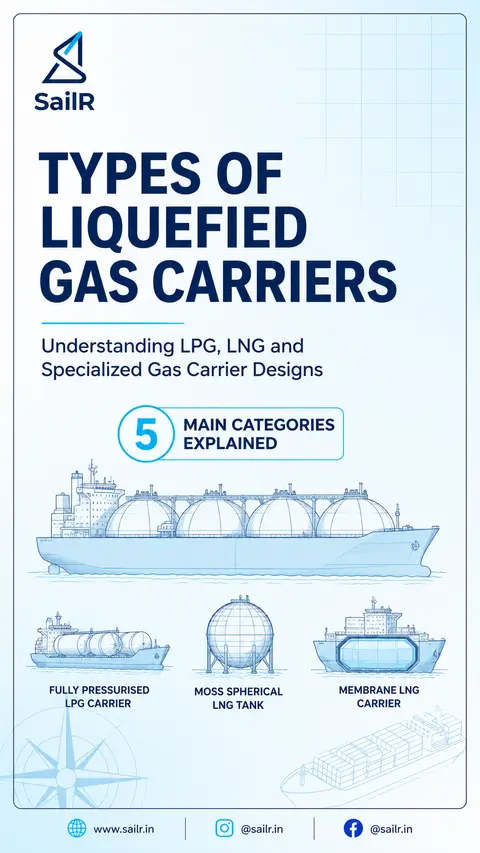
The slides, written out
AI-drawn illustration. Simplified to explain the idea, not to scale.
Slide 1 · TYPES OF
TYPES OF
LIQUEFIED
GAS CARRIERS
Understanding LPG, LNG and
Specialized Gas Carrier Designs
5
MAIN CATEGORIES
EXPLAINED
FULLY PRESSURISED
LPG CARRIER
MOSS SPHERICAL
LNG TANK
MEMBRANE LNG
CARRIER
Slide 2 · 5 TYPES OF
5 TYPES OF
LIQUEFIED GAS CARRIERS
Based on cargo type, carriage conditions and containment systems
1
FULLY PRESSURISED (FP) LPG CARRIERS
Cargo: LPG, anhydrous ammonia, VCM
Type C tanks, 15–22 bar
No refrigeration required
Small volumes, short-haul trades
CYLINDRICAL TANKS PROTRUDING ABOVE DECK
2
SEMI-PRESSURISED / SEMI-REFRIGERATED (SR) LPG / MULTI-GAS CARRIERS
Cargo: Propane, butane, ethylene, ethane, ammonia
Type C tanks, 4.5–8 bar
Temperatures down to −104 °C
Medium volumes, port-to-port flexibility
INSULATED PRESSURE TANKS FOR MULTI-GAS CARGOES
3
FULLY REFRIGERATED (FR) LPG CARRIERS
Cargo: LPG, ammonia
Type A prismatic tanks
Atmospheric pressure, ~−42 °C
Large volumes, long-haul trades
PRISMATIC TANKS, FLAT WEATHER DECK
4
LNG CARRIERS
Cargo: Methane (natural gas)
Fully cryogenic, ~−162 °C
Containment: Membrane / Moss Spherical / Type B (SPB) tanks
Large volumes: 145,000 to 266,000 m³ (modern range)
FULLY CRYOGENIC LNG CARRIAGE & BOG MANAGEMENT
5
CNG CARRIERS (COMPRESSED NATURAL GAS)
Cargo: Methane
High-pressure storage, typically several hundred bar
Niche trade, very limited deployment
HIGH-PRESSURE CYLINDERS CARRIED ON DECK
Slide 3 · LNG CONTAINMENT SYSTEMS
LNG CONTAINMENT SYSTEMS
COMPARING THE THREE MAIN LNG CARGO TANK TECHNOLOGIES
1
MOSS SPHERICAL TANKS (TYPE B)
2
MEMBRANE TANKS (TYPE B)
3
TYPE B SPB TANKS (PRISMATIC)
Independent spherical tanks self-supporting (Type B)
Thin membrane supported by insulation and secondary barrier, not self-supporting
Self-supporting prismatic tanks made of 9% Ni steel or Aluminium
ADVANTAGES
Proven design with long operational history
Easy access to tank dome for inspection
Robust independent Type B containment
Simple structural behaviour and well understood
ADVANTAGES
Best space utilisation – maximises cargo capacity
Higher cargo volume for a given hull size
Lower centre of gravity – improves stability
Flat weather deck – easier operations and cargo handling
Excellent thermal performance with multi-layer insulation
Industry standard – most widely adopted system
ADVANTAGES
Flat weather deck
Excellent resistance to sloshing pressures
Robust self-supporting Type B containment
Good operational experience in specific fleets
LIMITATIONS
Lower cargo efficiency – wasted space around equator
Higher centre of gravity compared to membrane
More steel weight for same cargo volume
Larger deck footprint
LIMITATIONS
More complex construction and installation
Requires high-quality insulation and precise workmanship
Dependence on ship's double hull for support
LIMITATIONS
Higher construction cost than membrane
Heavier compared to membrane systems
Limited adoption – niche application
KEY TAKEAWAY
All three systems provide safe and reliable LNG containment.
However, membrane tanks are the preferred choice for modern LNG carriers due to superior cargo capacity, lower centre of gravity and operational efficiency.
Slide 4 · WHY MODERN LNG SHIPS PREFER MEMBRANE TANKS
WHY MODERN LNG SHIPS PREFER MEMBRANE TANKS
ENGINEERED FOR MAXIMUM EFFICIENCY. BUILT FOR THE FUTURE.
MAXIMUM CARGO CAPACITY
Conforms to hull shape, eliminating wasted space and delivering the highest cargo capacity for a given hull size.
BETTER HULL UTILISATION
Membrane tanks fit within the hull envelope, optimising deadweight and revenue potential.
LOWER CENTRE OF GRAVITY
Cargo is carried lower within the hull, enhancing stability and reducing roll motions.
ENHANCED THERMAL PERFORMANCE
Multi-layer insulation with advanced materials ensures minimal heat ingress and lower boil-off rates.
PROVEN TECHNOLOGY
Over 50 years of continuous development and operational experience across thousands of LNG voyages.
DOMINANT MODERN NEWBUILD SOLUTION
Membrane containment systems (GTT Mark III & NO96) are the industry standard for modern LNG carriers worldwide.
THE BOTTOM LINE
Membrane containment systems dominate modern LNG carrier construction because they maximise cargo capacity while delivering excellent thermal efficiency, structural performance and operational reliability.
More Cargo
Better Efficiency
Greater Stability
Proven Reliability
Drafted by SailR from our daily lessons. AI-drawn illustration. Simplified to explain the idea, not to scale. Last updated 19 Oct 2026.
Spotted a mistake?