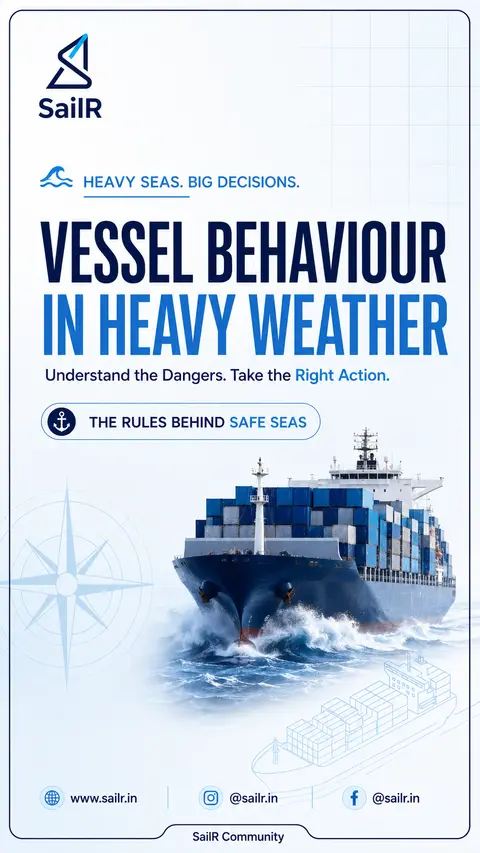
The slides, written out
AI-drawn illustration. Simplified to explain the idea, not to scale.
Slide 1 · HEAVY SEAS
HEAVY SEAS. BIG DECISIONS.
VESSEL BEHAVIOUR
IN HEAVY WEATHER
Understand the Dangers. Take the Right Action.
THE RULES BEHIND SAFE SEAS
Slide 2 · SLIDE 1 / 4
SLIDE 1 / 4
Vessel Behaviour
in Heavy Weather
Master's Decision Framework
Recognise the condition. Control the response.
KEY FACTORS
Wave Direction
Head • Following • Quartering • Beam
Wave Period & Length
Determine the encounter conditions
Wave Height
Higher waves can increase
dangerous responses
Ship Characteristics
Stability • Natural Roll Period •
Hull Geometry • Loading Condition
Ship Speed
Changes the wave
encounter period
THE 2 PRIMARY CONTROLS
COURSE + SPEED
The objective is to avoid dangerous
wave encounter and ship response conditions.
Heavy weather is not one problem.
Identify the specific dangerous
phenomenon first.
Slide 3 · SLIDE 2 / 4
SLIDE 2 / 4
FOLLOWING &
QUARTERING SEAS
3 DANGERS YOU MUST RECOGNISE
Heavy seas from astern can cause three important problems.
Recognise early. Act early.
01
SURF RIDING &
BROACHING-TO
On the steep foerfront of a
high following or quartering
wave, the ship can be
accelerated and surf ride.
Loss of control can lead to
broaching-to, with sudden
heading change and large heel.
135°
225°
DANGEROUS
ENCOUNTER ANGLE
135° < α < 225°
MASTER'S ACTION
Adjust COURSE and/or SPEED to move the ship
outside the dangerous surf-riding region.
Refer to the ship-speed criterion
from IMO MSC.1/Circ.1228.
02
REDUCED STABILITY
ON WAVE CREST
When the ship rides on a wave
crest amidships, changes in the
submerged hull form can
substantially reduce
intact stability.
Crest
Crest
Crest amidships
(critical condition)
POTENTIALLY CRITICAL
WAVE LENGTH
0.6L ≤ λ ≤ 2.3L
where L = ship's length
between perpendiculars
Amount of stability
reduction within this
range is nearly
proportional to
wave height.
Particularly dangerous in following and quartering seas
due to longer duration on the wave crest.
03
PARAMETRIC
ROLLING
This happens because of the
variation of stability between
the ship's position on the
wave crest and its position
in the wave trough.
If the timing matches the
critical relationships with the
natural roll period, roll amplitude
can build to very large values.
Crest amidships
Stability decreases
Trough amidships
Stability varies
Next crest amidships
Stability decreases
Cycle repeats wave after wave
Roll amplitude can build very large.
MASTER'S ACTION
Change HEADING and/or SPEED to break the critical
encounter-period condition. Do it early.
Avoid the critical relationships:
• T_E ≈ T_R (1 : 1)
• T_E ≈ 0.5 T_R (1 : 0.5)
BOTTOM TAKEAWAY
Following and quartering seas can rapidly lead to loss of control,
reduced stability and extreme rolling. Early action saves ships.
Slide 4 · PARAMETRIC ROLLING
PARAMETRIC ROLLING
WHEN THE ROLL STARTS TO BUILD
Parametric rolling can generate very large roll amplitudes
when the encounter period matches critical relationships
with the ship's natural roll period.
THE KEY RELATIONSHIP
NATURAL ROLL PERIOD TR
VS
ENCOUNTER PERIOD TE
PARAMETRIC ROLLING CAN BECOME DANGEROUS WHEN:
TE ≈ TR
OR
TE ≈ 0.5 TR
ENCOUNTER RATIO 1 : 1
ENCOUNTER RATIO 1 : 0.5
CREST AMIDSHIPS
Stability decreases
TROUGH AMIDSHIPS
Stability increases
NEXT CREST AMIDSHIPS
Stability decreases
IMPORTANT
Parametric rolling is NOT restricted to following seas. It can occur in:
FOLLOWING QUARTERING HEAD BOW BEAM
Depending on the ship's characteristics and wave encounter conditions.
Stability varies as waves pass along the ship. When the timing of this stability variation matches the critical relationship, energy builds the roll motion to very large amplitudes.
MASTER'S ACTION
CHANGE HEADING and/or SPEED to move the encounter period away from the critical condition.
TE ≠ TR
TE ≠ 0.5 TR
BOTTOM TAKEAWAY
Do not wait for extreme rolling before breaking the resonance condition.
Early action prevents large roll amplitudes and keeps the ship safe.
Slide 5 · SLIDE 4 / 4
SLIDE 4 / 4
MASTER'S QUICK RESPONSE
HEAVY WEATHER: WHAT DO YOU DO?
1 PITCHING / SLAMMING
Head seas can produce heavy pitching and slamming.
Slamming is not covered by MSC.1/Circ.1228 – consider separately.
ADJUST SPEED AND/OR COURSE
Avoid excessive pitching, slamming and dangerous wave encounter conditions.
2 SURF RIDING
Ship on the steep forefront of a high wave can be accelerated and surf ride.
IMO dangerous region for surf riding & broaching-to:
135° < α < 225°
(With applicable speed criterion)
CHANGE SPEED AND/OR COURSE
Move the ship outside the dangerous surf-riding region.
3 BROACHING-TO
Loss of control while surf riding may lead to broaching-to with sudden heading change and large heel.
Can endanger the ship and potentially lead to capsizing.
BREAK THE SURF-RIDING CONDITION
Adjust speed and/or course to regain effective directional control.
4 REDUCED STABILITY ON WAVE CREST
Riding on a wave crest amidships can substantially reduce intact stability.
Potentially critical wave length:
0.6L ≤ λ ≤ 2.3L
(L = ship's length between perpendiculars)
Effect increases with wave height.
AVOID DANGEROUS WAVE ENCOUNTER CONDITIONS
Consider wave length, wave height, stability condition and ship response.
5 PARAMETRIC ROLLING
Can occur in following, quartering, head, bow or beam seas when encounter period matches critical relationships.
Critical relationships:
TE ≈ TR or TE ≈ 0.5 TR
(TE = Encounter Period, TR = Natural Roll Period)
CHANGE COURSE AND/OR SPEED
Move away from critical encounter period relationships.
TE ≠ TR
TE ≠ 0.5 TR
FINAL MASTER RULE
IDENTIFY → ASSESS → ALTER → MONITOR
The safest action depends on:
SHIP
STABILITY
WAVES
SPEED
ENCOUNTER CONDITIONS
IMO MSC.1/Circ.1228 provides general guidance.
A ship may be unsafe even outside the defined dangerous zones if stability is insufficient. Consider your ship's actual condition and behaviour.
Drafted by SailR from our daily lessons. AI-drawn illustration. Simplified to explain the idea, not to scale. Last updated 19 Oct 2026.
Spotted a mistake?