The slides, written out
AI-drawn illustration. Simplified to explain the idea, not to scale.
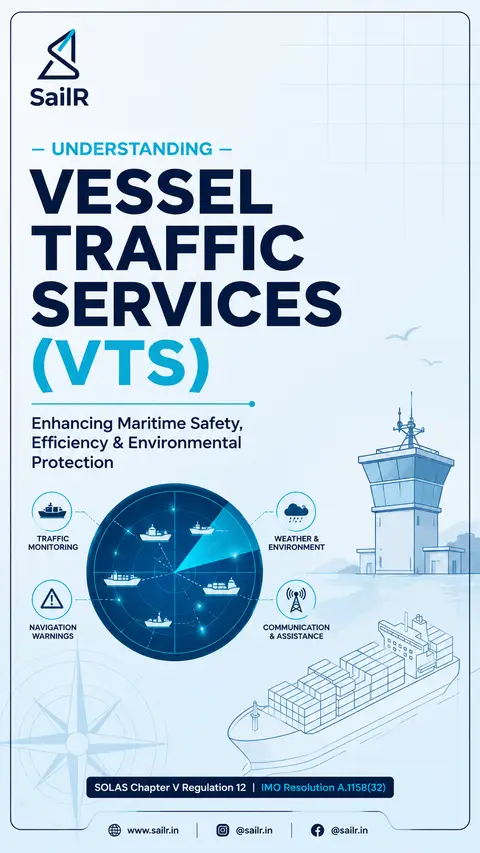
Slide 1 · — UNDERSTANDING —
— UNDERSTANDING —
VESSEL
TRAFFIC
SERVICES
(VTS)
Enhancing Maritime Safety,
Efficiency & Environmental
Protection
TRAFFIC
MONITORING
WEATHER &
ENVIRONMENT
NAVIGATION
WARNINGS
COMMUNICATION
& ASSISTANCE
SOLAS Chapter V Regulation 12 | IMO Resolution A.1158(32)
Slide 2 · — WHY MODERN SHIPPING NEEDS —
— WHY MODERN SHIPPING NEEDS —
VESSEL TRAFFIC
SERVICES (VTS)
VTS is a shore-based service that provides real-time information, traffic organization and navigational support to ships.
THE DEMAND OF MODERN SHIPPING
TRAFFIC DENSITY
• Increase in number and size of vessels
• Mix of tankers, ferries, fishing vessels & small craft in confined waters
• Bridge team alone cannot cover the full picture
OPERATIONAL EFFICIENCY
• Ports run on tight schedules
• Waiting at anchor is costly
• VTS optimizes berth utilization & traffic flow
RISK REDUCTION
• Margin for error is razor-thin
• VTS provides extra situational awareness
• Prevents collisions, groundings & environmental incidents
ENVIRONMENTAL PROTECTION
• Reduces risk of pollution & spills
• Supports compliance with international environmental regulations
• Contributes to sustainable shipping
VTS provides shore-based situational awareness and traffic management to support safe and efficient vessel movements and protect the marine environment.
Slide 3 · — THE THREE SERVICE LEVELS —
— THE THREE SERVICE LEVELS —
VTS SERVICES
EXPLAINED (INS, TOS, NAS)
VTS offers three levels of service. These can be provided separately
or in combination depending on the needs of the area and traffic.
1. INFORMATION SERVICE
(INS)
2. TRAFFIC ORGANIZATION
SERVICE (TOS)
3. NAVIGATION ASSISTANCE
SERVICE (NAS)
PURPOSE
Provides information that
affects the vessel's transit
to enhance situational
awareness.
PURPOSE
Actively organizes and
manages traffic flow to
improve safety and
reduce congestion.
PURPOSE
Supports the Master in
navigational decision-making
in confined or high-risk
situations.
KEY FEATURES / EXAMPLES
Traffic situations & other vessels
Navigation warnings & hazards
Weather, tides & currents
Status of navigational aids
Port related information
Non-authoritative service –
Master retains full responsibility
KEY FEATURES / EXAMPLES
Movement planning & scheduling
Traffic sequencing & route
allocation
Traffic clearances / movement
instructions (as authorized by
national legislation)
Congestion management
Monitoring & compliance
enforcement
KEY FEATURES / EXAMPLES
Position-related assistance
Warnings of dangers & risks
Recommendations on course
& speed
Channel guidance
Advisory service –
Master remains in control
All VTS services are advisory.
The Master is always responsible for the safe navigation
of the vessel.
| |
Slide 4 · CORE PRINCIPLES OF VTS
CORE PRINCIPLES OF VTS
THE GUIDING PRINCIPLES
BEHIND SAFE VOYAGES
VTS is implemented based on international regulations and best
practices to support safe, efficient and environmentally responsible
maritime operations.
1
SAFETY, EFFICIENCY &
ENVIRONMENTAL
PROTECTION
The core mission of every
VTS implementation.
2
ESTABLISHED WHERE
RISK OR TRAFFIC
JUSTIFIES
VTS is implemented only
where traffic volume or
risk warrants its need.
6
FLAG-STATE
ENCOURAGEMENT
OF PARTICIPATION
Contracting Governments
encourage their flagged
vessels to participate and
comply with VTS.
3
INTERACTION &
ASSISTANCE TO
MARINERS
VTS provides information,
advice and support to
enhance situational
awareness and safety.
5
SUPPORT FOR
SITUATIONAL
AWARENESS
VTS enhances the ability
of ships to make informed
decisions in complex
maritime environments.
4
COMPLIANCE WITH
INTERNATIONAL LAW
VTS operates in accordance
with SOLAS, UNCLOS,
COLREGs and other
applicable conventions.
VTS ACTS AS A CRITICAL LINK BETWEEN SHORE AUTHORITIES
AND SHIPS, IMPROVING SAFETY AND EFFICIENCY WHILE
HELPING PROTECT THE MARINE ENVIRONMENT.
Drafted by SailR from our daily lessons. AI-drawn illustration. Simplified to explain the idea, not to scale. Last updated 19 Oct 2026.
Spotted a mistake?