The slides, written out
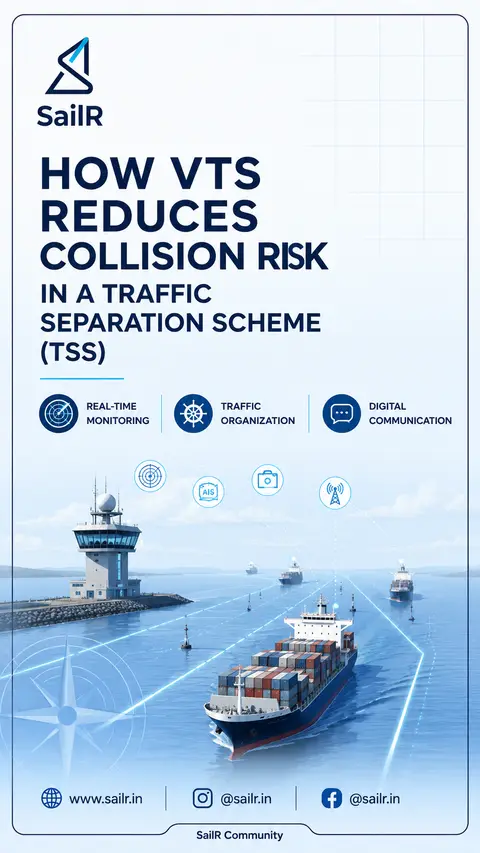
AI-drawn illustration. Simplified to explain the idea, not to scale.
Slide 1 · HOW VTS
HOW VTS
REDUCES
COLLISION RISK
IN A TRAFFIC
SEPARATION SCHEME
(TSS)
REAL-TIME
MONITORING
TRAFFIC
ORGANIZATION
DIGITAL
COMMUNICATION
Slide 2 · 02 / 04
HOW VTS
PREVENTS COLLISIONS
VTS centres combine technology, traffic management
and communication to detect risk early and
organize safe passage through a TSS.
01
REAL-TIME
SURVEILLANCE
• Radar, AIS, CCTV
and VHF DF create
a fused traffic picture.
• Early detection of
deviations, congestion,
and potential hazards.
02
TRAFFIC
ORGANIZATION
SERVICE (TOS)
Traffic is separated in
space, time and distance.
Depending on national
legislation and local
authority, TOS may
include:
SLOT
MANAGEMENT
TRAFFIC
CLEARANCE
ROUTE
INFORMATION
WATERWAY
MANAGEMENT
Assigning time
windows to reduce
bunching.
Imposing conditions
such as speed limits,
tug requirements or
route restrictions.
Providing recommended
tracks or waypoints
digitally to assist
compliance.
Advising on overtaking,
one-way traffic,
exclusion zones and
weather-based limits.
03
ENFORCEMENT
• Monitoring adherence to TSS rules,
speed limits and COLREGs.
• International signal "YG" may be
used to indicate apparent non-
compliance. Vessels should
immediately verify and take
corrective action.
04
DIGITAL COMMUNICATION
• Digital exchange via AIS ASM,
VDES and S-100 services
improves clarity.
• Route recommendations, clearance
conditions and hazard alerts can be
displayed directly on ECDIS or other
navigational equipment.
05
RECORDING & INVESTIGATION
• Radar, AIS and VHF communications are recorded.
• Data supports objective reconstruction and continuous improvement.
KEY TAKEAWAY
VTS provides an independent traffic overview that
supports safe navigation without replacing the
Master's responsibility.
Slide 3 · 03 / 04
VTS COMMUNICATION
SYSTEMS
A layered and redundant communication architecture
ensures safe, efficient and reliable information exchange.
SYSTEM | PURPOSE | KEY FEATURES
VHF RADIO
(Ch. 12, 13, 16 etc.) | Primary voice link for reporting, routing and emergency coordination. | Requires standardised phraseology (IMO SMCP). Essential for urgent, time-critical communication.
AIS
(Class A) | Automatic broadcast of ship identity, position, course, speed and destination. | VTS receives AIS data and correlates it with radar for a fused traffic picture. Used for digital messaging (AIS ASM).
VDES
(VHF Data Exchange System) | High-speed digital data link, supplementing AIS communication. | Supports S-100 product specifications and route exchange. Enables slot management and traffic organization messages.
RADAR
(X-band, S-band) | Long-range detection of all surface targets, including those not transmitting AIS. | Multiple remote radar heads linked to a single VTS centre. Operates in all weather conditions.
CCTV / IR CAMERAS | Visual identification in harbours, anchorage approaches and critical chokepoints. | Verifies compliance with tug connections, mooring arrangements, or illegal discharge.
IP-BASED COMMUNICATION | Internet/VSAT/4G for exchanging non-time-critical data. | Weather forecasts, digital sailing plans, port community systems. Reduces VHF congestion.
RECORDING SYSTEMS | All voice and radar data stored for incident reconstruction. | Supports investigations by flag States and casualty investigation bodies.
Integrated systems. Shared information. Safer seas.
VTS connects ships, technology and people for safer navigation.
| |
Slide 4 · 04 / 04
WHY VTS
MATTERS
VTS acts as a safety multiplier—providing situational awareness, structured communication and timely intervention to prevent incidents in busy and complex waterways.
PREVENTS CLOSE-QUARTERS SITUATIONS
Early detection and traffic organization reduce the risk of head-on and crossing scenarios.
IMPROVES SITUATIONAL AWARENESS
A complete, real-time overview of all traffic supports better decision-making on board.
SUPPORTS COLREG RULE 10 COMPLIANCE
Ensures adherence to the Traffic Separation Scheme and other navigational rules.
ASSISTS EMERGENCY RESPONSE
Quick coordination with tugs, SAR, pilot boats and authorities during emergencies.
RECORDS & POST-INCIDENT RECONSTRUCTION
Radar, AIS and voice recordings help investigators understand causes and improve procedures.
THE VTS SAFETY CYCLE
01 MONITOR Continuous surveillance of all vessel traffic.
02 DETECT Identify risks, deviations or non-compliance early.
03 INFORM Communicate with vessels using voice and digital messages.
04 ORGANIZE Apply traffic organization measures to maintain safe separation.
05 RESOLVE Ensure compliance and confirm safe passage.
06 RECORD Store data for review, investigation and continuous improvement.
KEY REFERENCES
SOLAS Chapter V Regulation 12 VTS is recognized as an important measure to improve navigational safety.
IMO Resolution A.1158(32) Guidelines for Vessel Traffic Services.
MSC.1/Circ.1610/Rev.1 Digital Maritime Services in the context of e-navigation.
IALA Guideline G1089 Provision of a Vessel Traffic Service (VTS).
VTS enhances safety, protects the marine environment and supports efficient maritime trade.
Drafted by SailR from our daily lessons. AI-drawn illustration. Simplified to explain the idea, not to scale. Last updated 19 Oct 2026.
Spotted a mistake?